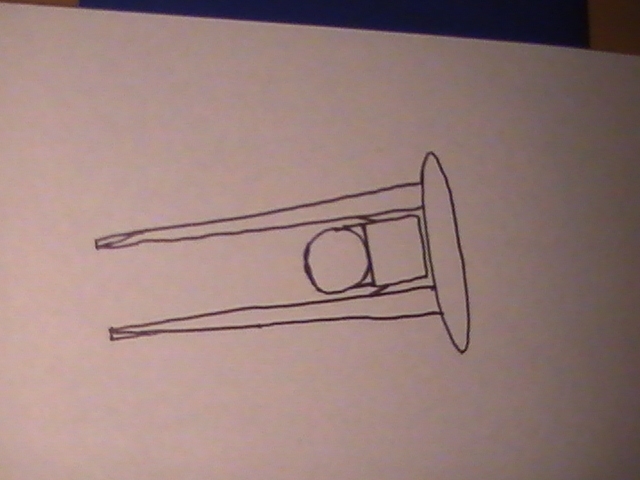
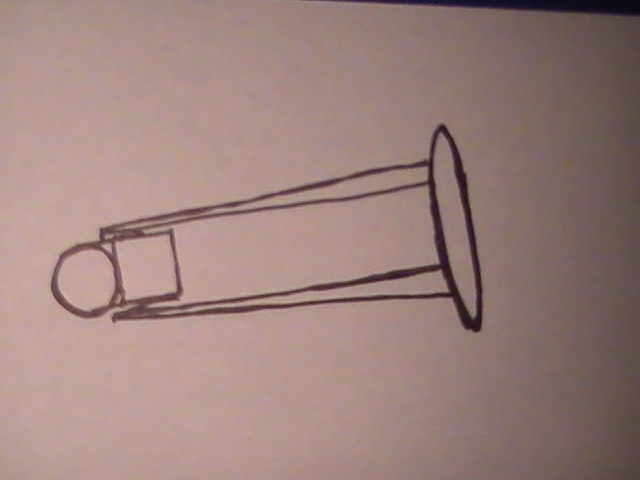
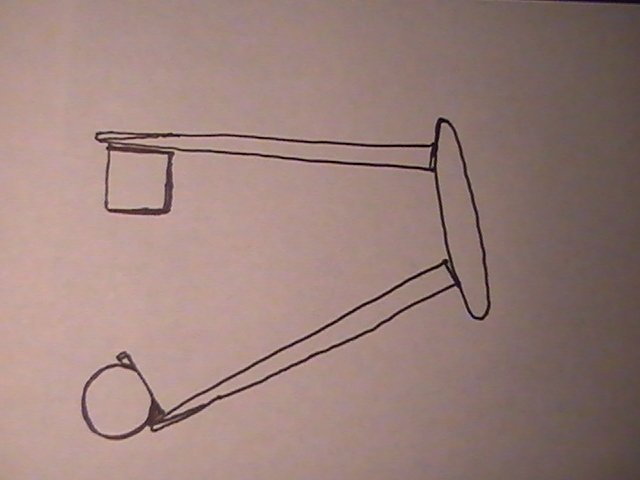
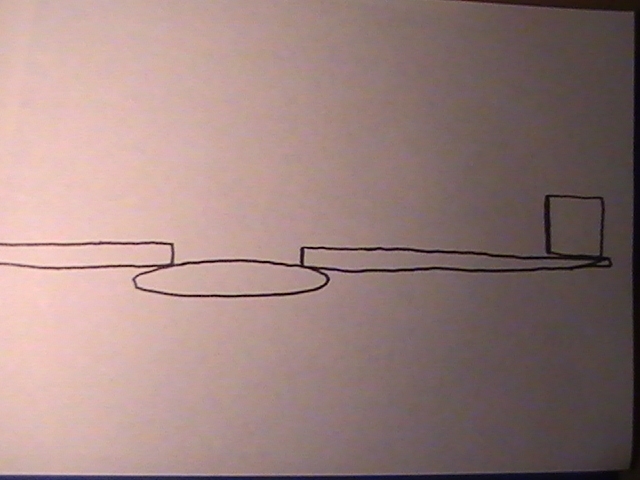
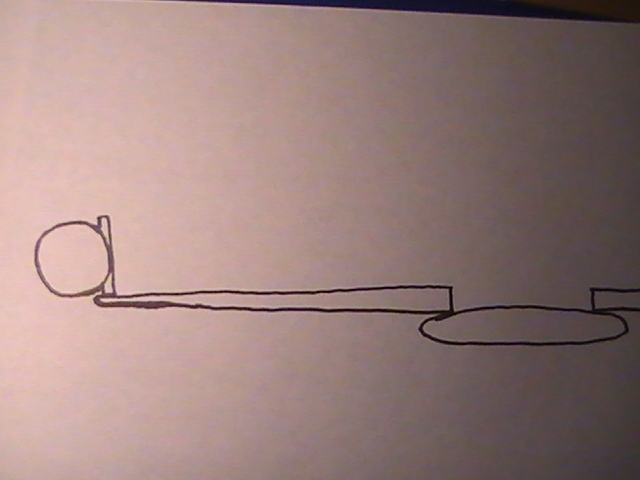


Most Americans are familiar with water towers and these towers are fascinating examples of the necessary minimum dimensions of what could be called a “true” spaceship. The definition of a true spaceship is a craft that can carry human beings on interplanetary journeys while providing an Earth gravity/radiation environment. The last part is what determines most of everything else- radiation is square one. As Eugene Parker has stated in his articles concerning the heavy nuclei component of galactic cosmic radiation, the only guaranteed solution to shielding space travelers is mass and distance. Mass on the order of 500 tons and a distance of about 15 feet- with water being the most utilitarian shielding material. Since this figure would protect only a minimum crew area the size of a small capsule, for long duration missions the psychological space necessary for mental health equates to a realistic shield way over 1000 tons. To push such a shield around the solar system at a speed that will allow missions to the gas and ice giants lasting 3 to 5 years only one form of propulsion is practical: H-bombs.
The two most difficult challenges when using nuclear pulse propulsion are first the scale required for an efficient engine and then where it can be fired. The “engine” used in pulse propulsion is essentially a metal disc massing a minimum of several thousand tons. The reason for the over one hundred foot diameter disc is the difficulty in building a small enough bomb to be efficient. The larger the disc, the larger the bomb that can be used and since H-bombs all use a standard amount of fissionable material with small amounts of tritium and deuterium added for the fusion reaction, pulse propulsion efficiency increases with size. As the disc approaches a thousand feet in diameter the Isp numbers soar into the tens of thousands. Lighting off H-bombs in the Earth’s magnetosphere results in fission byproducts being sucked down into the atmosphere and since this sphere extends almost to the Moon, the Moon is the jumping off point for interplanetary travel.
The remaining question is how to acquire the plate. The shielding can be had by way of lunar ice but bringing the disc up from Earth is problematic. Fabricating the engine from lunar titanium would be ideal but requires a factory. Giant lava tubes are theorized to exist beneath the surface of the Moon and these could serve as factory floors. An underground lunar factory with several hundred workers does not seem to be a possibility in this half of the century. The prerequisite is a Super Heavy Lift Vehicle much larger than the current SLS and flying at a rate the shuttle only aspired to (just before Challenger the shuttle had 15 launches planned over the following year of operations). These SHLV’s would probably have reusable pressure fed boosters (originally proposed for the shuttle) and would also most likely fly the main engine module around the Moon on a free return back to Earth reentry and also be recovered at sea.
If a lava tube site was found and after about a ten year development period this proposed SHLV could fly around ten missions a year for the next ten years at the end of these two decades a factory capable of producing pulse propulsion discs several hundred feet in diameter might be ready to start up. The first of a fleet of lunar production spaceships is a possibility by the year 2040. Perhaps even before my eightieth birthday. By 2040 there should be a dozen or so crewed wheels in GEO providing telecom services. The questions that arise concerning this move into space are what kind of ship can serve as an interim to move the nuclear arsenal into deep space in the decades before lunar production begins? There is also the ultimate goal of Space Solar Power satellites and Bernal Spheres which will be the focus of the second half of the 21st century.

 oldAtlas_Eguy


“A reusable Extraterrestrial landing vehicle could operate between the Earth-Moon Lagrange points and LEO and between the Lagrange points and the lunar surface using propellant derived from lunar water. A super heavy lift vehicle is great for deploying heavy cargo within cis-lunar space but its an inefficient crew launch vehicle since it throws away all of its components– every launch. This makes it necessary for the lander to dive 20,000 miles from GEO into LEO to pick up human beings and then boost out of LEO- presumably with propellants taken on at a fuel depot. What a mess. The Super Heavy Lift has to “throw away it’s components” but it can reuse them. And all the humans are on Earth right now so…..
Chemical rockets operating between the Earth-Moon Lagrange points and high Mars orbit would be much more efficient than nuclear rockets operating between LEO and high Mars orbit– because of the substantially lower delta-v requirements when launch vehicles from the Lagrange points. Plus the delta-v requirements to supply water and propellant for interplanetary vehicles launched from the Lagrange points is substantially lower than trying to supply fuel and water from the Earth’s deep gravity well. Nuclear rockets would never be allowed to operate in the magnetosphere, let alone in LEO or GEO.
IVF technology being developed by the ULA will enable us to utilize hydrogen and oxygen very efficiently. That piston engine is no miracle solution and while it might work well maintaining oxygen for an extended mission, hydrogen is a whole different set of problems.
Commercial crew vehicles will been in operation long before the SLS is launching humans into space. Perhaps, but it is meaningless since they are not going anywhere except LEO and that is nowhere.
Marcel