More TSR Comments

From Apollo 4 story:

Dosing and debilitation are remedied with massive water shielding and tethers. Not really any other options except accepting dosing and debilitation which is….unacceptable. Trivializing these two most critical problems is the standard response but…obfuscation, denial, and misinformation is not going to fly when it is obvious radiation and zero gravity will certainly wreck the health of astronauts on long missions.

Containing a kiloton range water shield and spinning it for one gravity is best dealt with by using a structure already built to take multiple G loads- the spent upper stage. Thus, the wet workshop becomes the way to go and the shallow gravity well to dip those thousands of tons of spaceship water out of is the lunar poles. Robot landers can be used to extract and shuttle that water-derived-from-ice from the surface of the Moon to the workshops in Low Lunar Orbit (LLO). So LEO is a dead end and LLO is the place to go.

This leads to the only practical system for pushing such a multi-thousand ton mass around the solar system: Nuclear Pulse Propulsion (hydrogen bombs). Or…as you called it, “NuSpace”. LEO is the worst place to assemble, test, and launch such nuclear missions. In the short term Solem’s Medusa-type spinnaker sail can be used while in the long term the lunar-manufactured monolithic plate. In the short term the shuttle-heritage propulsion and powerful Launch Abort System of the SLS could transport appropriately packaged bomb pits directly to the vicinity of the Moon. In the long term lunar thorium could be transmuted into bomb-grade material.

From Bridenstine  story:

NASA needs to focus on the deployment of SLS wet workshops to Low Lunar Orbit (LLO), and robot landers to the surface of the Moon. Once such robot landers begin shuttling In Situ Resource Utilization (ISRU) propellant and water-as-shielding payloads for the workshops then such technology should provide Lunar Cyclers and LLO habitats for astronauts. With tether systems providing 1G this will enable a sustained long term human presence Beyond Earth Orbit and a spaceship/space station construction pipeline.


TSR Engine Wars comments

Jeff Foust has allowed me to post comments on his blog “The Space Review” and I have linked Ice on the Moon with those comments. I am in fact surprised none of the people replying to my comments have been here yet. They will come. Here are some of my comments from the review:

“It was actually addressed in the shuttle program with the pressure-fed ocean recovered booster. Perhaps the single most egregious wrong turn in the space program was going with the SRB as a cost-cutting measure. The pressure-fed ocean recovered booster is still the missing piece of technology required to enable efficient Super Heavy Lift Vehicle operations. As I have commented many times, Musk and Bezos both failed the genius test by not going straight to the 1972 TRW booster study as a model.”

And, after some wailing and gnashing of teeth replies:

“I guess I should address the validity of the supposed “shortcomings” of pressure-feds:

1. Yes, pressure-feds are built to contain high pressure which means they are quite tough and will last…for repeated launches. The Ares 1X SRB casings were some of the original ones from the 80’s so these kind of boosters can be reused, unlike others, without worrying about their fragility.
2. Comparatively little extra mass is added in regards to pressure supply and this pressure provides even more structural integrity to add to the already robust heavy duty structure.
3. Parachutes add comparatively little mass and are…reusable.
4. Recovering the boosters for reuse by ship is part of the no-land-back reuse scenario. Land-backs require far more powered maneuvering, throttling, landing arrangements, fuel, etc.

The land-back concept, whether to land or barge, subjects the far more fragile non-pressure-fed to a harder landing and requires fuel and landing gear mass. Considering the inspections required to turbopumps and structure the pressure-fed may very well come out ahead in efficiency (and of course, price). The critical advantage is the multi-million pound thrust of ocean recovered boosters compared to much smaller land-back concepts.”

And after a comment about space plane type return of engines after launch:

“I have to disagree. In terms of simple the pressure-fed being parachuted into the ocean simply cannot be beat. I would add that a core stage going to the Moon could actually separate the engine group from the stage after escaping Earth gravity, do a free return around the Moon back to Earth, and with heat shield, parachute, and salt water protection system, also be recovered at sea for reuse. This would allow the empty core stage structure to continue on to Low Lunar Orbit (LLO) and be utilized as a wet workshop.”

And after a fairly ridiculous comment criticizing the wet workshop concept:

“How do you make this stuff up? The Wet workshop is not built in space, it is built on the ground and components stored as payload separated from the tanks. The equipment is moved into the tanks and bolted down in space when the tanks are no longer “wet”. Hence, the “workshop”. It has always been a no-brainer this is the way to go. Except of course, it you are promoting a rocket not big enough for practical wet workshop applications.

The wet workshop cannot be beat because it turns the empty fuel stage into crew quarters and is thus the ultimate reuse scheme. It has been the case for years that anything not found on the flagship company website by NewSpace advocates is denigrated and dismissed. Sad.”

“I would suggest the next iteration of the SLS be built for placing a wet workshop core in Low Lunar Orbit (LLO) using the payload- a lunar lander- engine for the burn. This iteration would also make use of advanced boosters built as pressure-fed ocean recovered components supplying hydrogen and oxygen propellants to the core stage engine group during the initial launch phase. Studies were done of Saturn V designs with this feature and the falcon heavy was also proposed with a propellant cross-feed system.

The core stage would achieve escape velocity and head for the Moon at which point the engine group would separate and follow a free return around the Moon back to Earth, re-enter with heat shield, salt water protection system, and parachute into the ocean for reuse. The empty stage with lunar lander attached as payload would use the lander engine to insert into Low Lunar Orbit. The lander would then descend to the ice deposits and from the ice take on a load of water and manufacture new propellants.

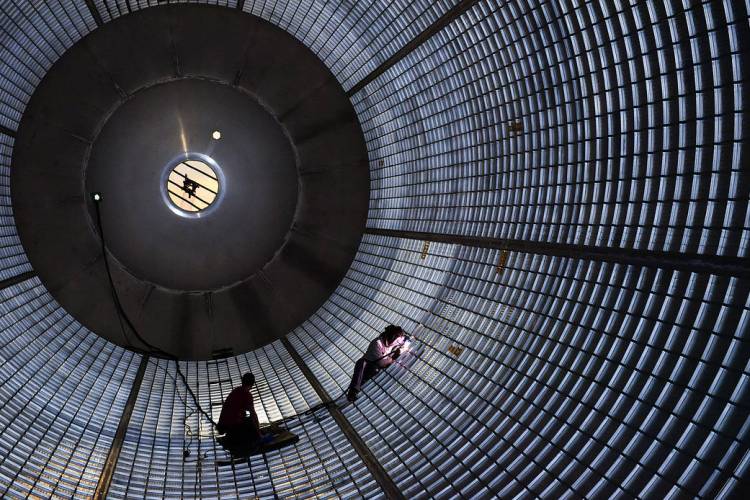
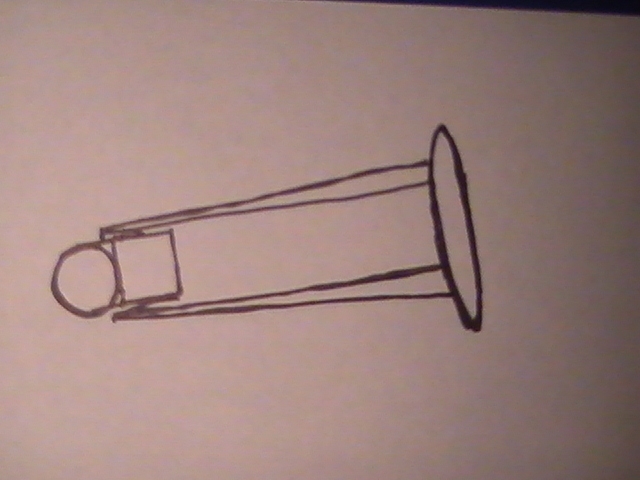
The semi-expendable robot lander would then make repeated trips between the surface and the workshop to transfer water-as-radiation shielding. When the radiation shield was full then two such workshops would be connected with a tether system and spun up to 1 gravity. With massive kiloton range water shields providing a near-sea-level radiation environment and artificial gravity astronauts arriving from Earth would suffer no dosing or debilitation. With large enough living quarters these astronauts could manage tours of several years without any physiological damage.”

And after a typical NewSpace-state-hate-libertarian reply:

“Government efforts are why we are in space- not “private” efforts. You are practicing blatant cognitive dissonance. There is not going to be any “free” space station. There is no cheap. The only significant revenues coming from space are GEO telecom satellites, the rest is fantasy. Only state sponsored programs using Super Heavy Lift Vehicles will expand the human presence into the solar system. “Private space” is a stumbling block as long as the fans keep pushing their tourist and Mars fantasies.

The reality is Skylab was large enough to test the wet workshop concept but was only funded as a dry workshop. For want of a few million dollars a space station with a larger interior space than the ISS could have been sent up in one evening for about the cost of one shuttle launch. The “reusable” shuttle, which threw away a most useful structure and instead brought up small pieces one at a time over a decade resulted in a 180 billion dollar Albatross that is now in the process of dying of old age. While the workshop has equipment installed from a payload area the inflatable of course has a problem with bolting anything down.

The entire inflatable concept is inherently flawed in terms of a space station or spaceship crew compartment if artificial gravity or powered maneuvering is required. It originated with not having a large enough stage to use as a wet or dry workshop. Private space does not have what it takes.

An inflatable might work in a lava tube on the Moon.”

And last of today:

“From wiki:
“-the M-1 project was uprated from 1.2 million pounds force to a nominal 1.5 million pounds force, and the designers deliberately added more turbopump capability to allow it to expand to at least 1.8 million pounds force and potentially as high as 2.0 million pounds force.[1]”

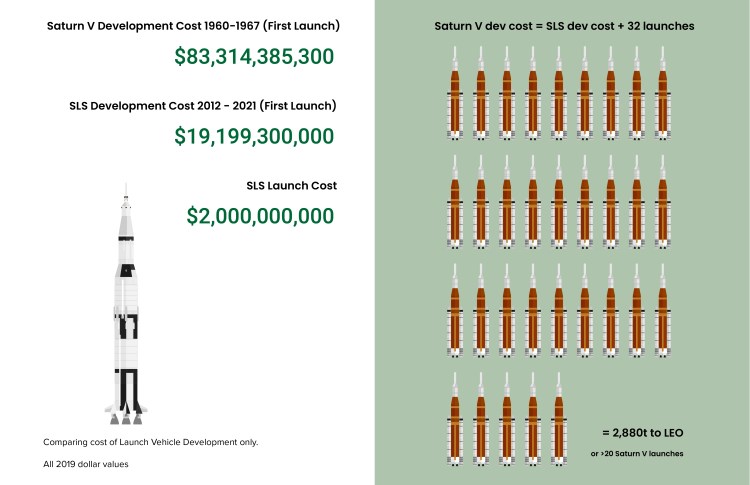
The SLS is presently being built with four RS-25 engines when a single M-1 would do the trick. No really big engines that compare with past efforts are being contemplated. Concerning these new engines a contest between satellite launch concerns is a better description than “engine wars.”

Human Space Flight Beyond Earth Orbit (HSF-BEO ) is going to require Super Heavy Lift Vehicles with those really big engines. My favorite was always the “notional” 325 inch solid with 15 million pounds of thrust. A pair of those (actually they were proposed mounted quad) would triple the thrust of the SLS. But the environmental concerns with SRB’s are not going away and a pressure-fed is the better direction to go in for advanced SLS boosters. The problem is the solid fuel lobby is not going to like a new pressure-fed booster in development taking money out of their pockets.”

SpacePolicyOnline won’t post this…

Halting the militarization of space can best be accomplished with large geosynchronous orbit human crewed platforms serving as sovereign territory of various nations. With all telecom interests concentrated on these space stations the rest of near Earth space can be laser-broomed clean of all junk and overflights by military satellites in low orbits strictly regulated.

The main obstacle to solving the problems in space is of course radiation. A human presence anywhere Beyond Low Earth Orbit (BLEO) will require massive shielding. The ice on the Moon, harvested by robot landers, and the derived water transferred to wet workshops in cislunar space, can provide the tens of thousands of tons of shielding that will be needed for the initial chain of telecom platforms.

The landers can convert a fraction of the ice they harvest into fuel, and in a semi-expendable fashion maintain a pipeline of water and chemical propellants to facilitate a cislunar infrastructure. A shuttle era schedule of Super Heavy Lift Vehicle missions with capabilities exceeding a minimum lift of 100 tons (like the SLS) for the next 30 years would not only effect a chain of large GEO space stations around the Earth but also create a pipeline for spaceship construction.

Of special interest to Secretary Wilson would be the eventual transfer of the nuclear deterrent into deep space on human-crewed spaceships and the ratcheting down of the present launch-on-warning scenario. As well as providing for deflection of comet or asteroid impact threats to Earth.

The plans by NewSpace “entrepreneurs” to essentially flood Earth orbit with cheap and nasty networks of thousands of mini-satellites is the opposite path that will immensely complicate any efforts to establish stability and sustainability in near Earth space.

But SpacePolicyOnline did post this:

The problem with this (space travel) is what I call “The Parker-Dyson-Spudis continuum” and I have yet to have a single person put forth a convincing argument against it. It goes like this:

1. Due to the heavy nuclei component of galactic cosmic radiation there is only one guaranteed way to protect astronauts from dosing during long duration deep space missions- as detailed by Eugene Parker- this requires about 500 tons of water or plastic for a small capsule. For a spaceship water is the utilitarian choice and for any practical living space the compartment would need well over a thousand tons.

2. The only practical system for pushing a kiloton range water shield Beyond Earth and Lunar Orbit (BELO) on an interplanetary mission is Nuclear Pulse Propulsion (specially designed atomic or more likely hydrogen bombs). The work of Freeman Dyson on Project Orion infers such a system could only be used outside the Earth’s magnetosphere. Star Wars data on directed energy weapons research and the global stockpile of bomb grade material further validate this concept.

3. The only shallow gravity well available from which to acquire the water shielding and assemble, test, and launch a nuclear mission (outside the Earth’s magnetosphere) is the Moon. The work of Paul Spudis enables exploitation of the ice resources at the lunar poles and the creation of a cislunar infrastructure capable of supporting construction of a true spaceship capable of interplanetary travel.

More Comments for Dr. Spudis

We live at the bottom of gravity well that dictates design, analoguous to Feynman’s quote- “For a successful technology, reality must take precedence over public relations, for nature cannot be fooled.”

This means that no matter how many sci-fi movies portray SSTO and no matter how many NewSpace infomercials scream cheap, “there is no free lunch.” By the way, the other famous Heinlein quote about Earth orbit being “halfway to anywhere” was revised to “Low Earth Orbit” as a NewSpace marketing ploy – He never said LEO and may just as easily have meant GEO.
LEO is not really space and is a dead end.

To achieve escape velocity (not so much orbital velocity) hydrogen upper stages are almost a necessity. To go anywhere Beyond Earth and Lunar Orbit (BELO) with humans requires massive shielding and chemical propulsion will not work. Only nuclear energy can push such mass (until some kind of beam propulsion infrastructure exists). That said, the only practical form of nuclear propulsion is “pulse” or, to put it bluntly, bombs.

This means that inside the Earth’s magnetosphere only chemical propulsion is practical due to fallout eventually being sucked into the atmosphere. This works out fine because just outside the magnetosphere is the Moon and that is where we have to go for the water-as-radiation-shielding anyway.

To keep this as short as possible, only progressively more powerful iterations of a Super Heavy Lift Vehicle used in a state sponsored public works project to develop a cislunar infrastructure has any chance of success. NewSpace is a scam that ends in the dead end of LEO.

And that makes their flagship companies inferior lift launch vehicle a hobby rocket.

NewSpace has been doing one thing for years yet nobody ever talks about it: the Ayn-Rand-in-Space Musk groupies damn the space agency and cal for it to be done away with on one page and praise NASA for pouring several billion tax dollars into commercial cargo and commercial crew on another.

They have nothing bad to say about the over one hundred billion dollar space station to nowhere yet curse all government “porkonaut projects” not connected to SpaceX (like the SLS) as pure evil. If these two-faced deceivers were not so damaging to the future of space exploration their idiotic contradictions would be funny.

Three very easy to digest sources giving some understanding to the situation concerning space exploration. Also very indicative of the complete inadequacy of NewSpace efforts.

1. https://engineering.dartmouth.edu/~d76205x/research/Shielding/docs/Parker_06.pdf

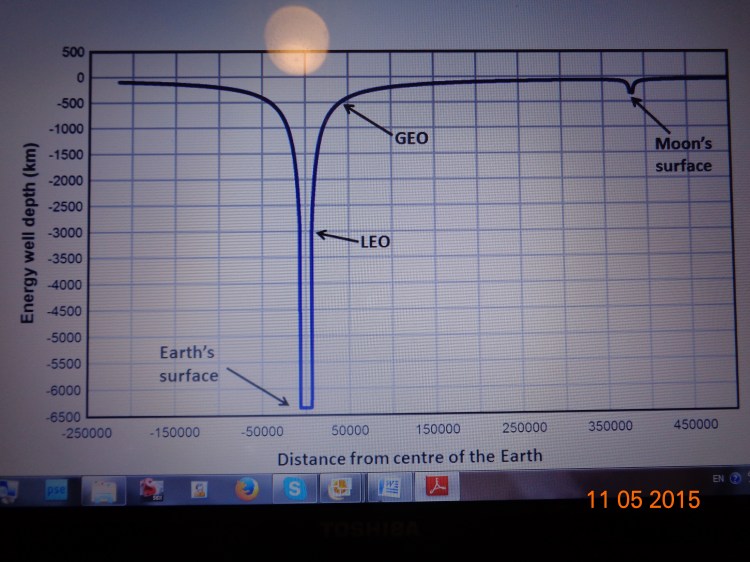
2. Infographic (on page 23 http://www.homepages.ucl.ac.uk/~ucfbiac/Lunar_resources_review_preprint_accepted_manuscript.pdf) depicting the depths of the Earth and Lunar gravity wells.

3. http://www.astronautix.com/engines/325solid.htm

Anybody with basic critical thinking skills can figure out how these examples apply to Human Space Flight Beyond Low Earth Orbit (HSF-BLEO). Unfortunately there are those so completely brainwashed by NewSpace infomercials they cannot process this basic data, so I will supply some hints:

1. Radiation? LEO is not really space; it has about as much in common with the space environment above LEO as a catfish pond does with the North Atlantic.

2. Water? The only place to get the shielding required for HSF-BLEO is the lunar poles.

3. Spaceships? Super Heavy Lift Vehicle iterations far more powerful than the evolved SLS are necessary for constructing a cislunar infrastructure. Saying anything otherwise is completely false and misleading.

The Apollo 1 fire made the aerospace industry take a step back from Human Space Flight and look to defense for profits. The 1972 Solar Flare would have killed or profoundly dosed an Apollo crew if they had been in transit to or from the Moon. Skylab’s main instrument was a solar telescope to try and predict solar events so as to allow missions Beyond Low Earth Orbit (BLEO) without having crews in constant danger. Space weather is still not predictable and probably never will be. All this points to hobby rockets and entrepreneurs as simply incapable of “opening the solar system up.”
It’s a scam.

NewSpace is essentially an Orwellian construct that will deliver exactly the opposite of what it promises. There is no cheap.

Letter to Paul

After watching this downhill slide into mediocrity for years I have to say in regards to space there is no truer maxim than “truth is stranger than fiction.”

There are a short list of guiding principles concerning space exploration that are simply ignored in a bizarro manifestation of collective cognitive dissonance. They are simple truths that for whatever reasons- be they political or ideological or vested interests in some scam- are not acknowledged by the powers that be and completely denied by those who have vested interests in quite different agendas. Here we go:

1. Radiation is square one. Beyond Low Earth Orbit a sustained human presence requires massive radiation shielding. Eugene Parker spelled this out clearly in language the public could understand in 2006. There is no dancing around the minimum of something like a thousand tons of water to shield a small spaceship crew. The NewSpace and Mars zealots go into automatic denial mode over this. They blather every kind of nonsense imaginable to obfuscate on this issue.

2. There is only one practical propulsion system for pushing such massively shielded constructs around the solar system- as spelled out by Freeman Dyson half a century ago- Nuclear Pulse Propulsion using atomic bombs. The eye-roll factor on this one is an order of magnitude greater than 1000 ton radiation shields. Like the space radiation elephant in the room, pulse propulsion is simply verboten in any serious discussion because…..it is. Yet it remains and will remain the only solution to Human Space Flight Beyond Earth and Lunar Orbit for the foreseeable future. And it is incidentally the ideal method of lifting millions of tons off the surface of the Moon.

3. A simple infographic (on page 23 http://www.homepages.ucl.ac.uk/~ucfbiac/Lunar_resources_review_preprint_accepted_manuscript.pdf) depicting the depths of the Earth and Lunar gravity wells shows that bringing water up out of Earth’s gravity well is a non-starter while the Moon is absolutely and without question (as spelled out by the work of Paul Spudis) the very best place to go to get that radiation shielding. Such a graphic representation (which I have cited a couple times in comments here) also clearly shows that LEO is not really space. It is halfway to nowhere despite NewSpace hype. The true boundary of outer space is Geosynchronous Earth Orbit (GEO) and this domain is also where the over 100 billion dollars in satellite revenues are to be had.

I could go on but these three, which form what I call the Parker-Dyson-Spudis continuum, are enough to show how divorced from reality we are as a civilization concerning space flight.

Letter to Marcia Smith

Since she will not post any more of my comments on Space Policy Online, I will just have to post them here. In response to http://www.spacepolicyonline.com/news/bridenstine-releases-american-space-renaissance-act-welcomes-comment

We will either choose to establish humans in space- to expand humankind off world- or we won’t. That is the choice and everything revolves around choosing to do so or playing games that dance around a lack of resolve.

Radiation is square one. Massive shielding is the elephant in the room and the only place to get it is the lunar poles. The only way to dip this water out of the shallow lunar gravity well is to start a new 30 year program of Super Heavy Lift Vehicle launches as the successor to the shuttle. That would be the SLS.

Abandoning the dead end of LEO and Mars is the only logical course. If NewSpace wants to redirect their efforts into lunar landers that will be fine. If they want to continue to pursue their LEO tourist empire fantasy then they will continue to be the worst thing that has ever happened to space exploration.

Dr. Spudis has returned to the blogsphere after a short absence and I have posted several comments on his latest post:http://www.spudislunarresources.com/blog/2016-columbia-medal-of-the-american-society-of-civil-engineers/

Your comment is awaiting moderation.

The video was excellent except for the fuel depot nonsense at 16:30.

4:00 Whipple and Shackleton anomalous craters almost certainly contain ice and have almost constant solar energy exposure. These two places at the poles should be the focus of all space exploration advocates. These lunar resources are the gateway to the solar system. The first 5 minutes of the presentation make NewSpace efforts look like the bored billionaire hobby projects they are.

11:00 The use of water as an energy storage medium using solar energy and fuel cells, as radiation shielding, and as rocket fuel was explained really well. Radiation shielding is my main concern and getting that water into lunar polar “frozen” orbit and into wet workshops in my view the critical step in building true space stations and eventually spaceships.

13:00 Radiation is square one. Robot landers to harvest ice and volatiles and shuttle water shielding into lunar orbit is the quickest way to establish a permanent human presence Beyond Earth Orbit. The ice on the Moon is THE critical resource for Human Space Flight. An understanding that LEO is not really space is what is needed for the public to support space exploration.

13:50 “Combined together in some future heavy lift vehicle” being the SLS of course. There really is no substitute for sending a Super Heavy Lift Vehicle to the Moon 6 to 8 times a year in the same way we sent the Shuttle into LEO for 30 years. Abandoning LEO and Mars and focusing exclusively on lunar resources is the only path that makes any sense at all.

14:50 The volatiles in the ice is important not only for industrial processes to make fuel (in my view methane is a more appropriate propellant than hydrogen for initial production) but also for…agriculture. An independent human colony will have to grow it’s own food of course.

17:00 and 18:00- Sending the iterations of the SLS to the Moon for the next 30 years like we sent the Shuttle into LEO is really the only option in my view. Future iterations would use pressure fed ocean recovered boosters and send empty upper stage wet workshops into lunar orbit. These workshops would be used first as “long duration” human crewed GEO space stations and eventually with nuclear propulsion systems as true spaceships.

http://www.denverpost.com/business/ci_29772777/nasa-getting-closer-boots-mars-colorado-companies-help

“Newman said that after 15 years of work on the International Space Station, and with all the research and technology development, NASA is well on its way to helping humanity become interplanetary.”

The Deputy Administrator is pushing the same old Mars/LEO dead end that has trapped humanity in Earth Orbit since 1972. The monumental wrong turn was retreating from the Moon and the only salvation is turning our eyes back on that prize.

From Marco Caceres, senior analyst and director of space studies for Teal Group Corp., a provider of aerospace and defense market analysis:
“Now you’re seeing private industry dominate the headlines. At some point, the public starts to wonder, ‘What is NASA good for again?’ ”

Something has to happen to get the U.S. space program off this road to failure. I am hoping Dr. Spudis’ book will be a wake up call to the public. The last book about space to really make an impression on the citizenry was “The High Frontier” by Gerard K. O’Neill in 1976.
Almost completely forgotten now.

https://www.flightglobal.com/news/articles/moon-or-mars-lockheed-preps-orion-for-deep-space-ad-424203

It was always obvious to me the SLS is a Moon rocket. As it gets closer to flying the NewSpace crowd is going to go nuts- it is the single most serious threat to their LEO tourist empire fantasy.

Hopefully Dr. Spudis’ book will help expose the whole ridiculous mess.

http://www.forbes.com/sites/brucedorminey/2016/03/24/china-likely-to-beat-nasa-back-to-the-moon/#66f03fac604c

30,000 views of this story so hopefully more articles will flood the media after the book comes out. The problem of course will be the NewSpace mob playing their standard disgusting game. The comment by Boozer really made me mad.

So sick of them. At this point they believe the barge landing has given them the last word with the public and that everybody believes their scam without question. No criticism of NewSpace, the flagship company, or the demi-god is allowed anywhere (except here).

RealSpace or NoSpace

RealSpace or NoSpace

By Gary Michael Church

The 1967 Apollo 1 fire was the key event leading to the end of the 1st space age before it really began. Anticipation by the aerospace industry of astronomical profits came to an abrupt end in one afternoon. It was not the three fatalities that doomed the space age, as aviation mishaps every year before and since result in hundreds of civilian deaths. The realization that space was going to be hard money would be the catalyst that shifted the focus of industry. The problem was that cold war toys generating vast revenues did not really have to perform as required and spaceships had to work as advertised. Concerning Human Space Flight, there are no false promises or rigged tests bringing in money because actual space travel cannot be faked. Industry chose the easy defense money. Despite recent public relations efforts proclaiming a new age of cheap lift the reality has not changed.

There is no cheap.

At the end of 1968, 22 months after Apollo 1, Apollo 8 left the gravitational field of Earth. Human beings left Earth orbit on December 21st to orbit the Moon and the space age began. Four years later the space age ended when Apollo 17 splashed down on December 19, 1972. The Apollo 8 mission lasted six days, Apollo 10 eight days, Apollo 11 another eight days, Apollo 12 ten days, Apollo 13 five days, Apollo 14 nine days, Apollo 15 twelve days, Apollo 16 eleven days, and Apollo 17 twelve days- for a total of 83 days. Those nine missions over four years totaling a week short of three months Beyond Earth Orbit were the space age. Very soon a half a century will have passed since human beings left Earth. A repeat of the Apollo 8 mission is tentatively scheduled for 2023 but the future of the under-funded and highly criticized Space Launch System is in doubt. These SLS critics are almost all NewSpace fans with an Ayn-Rand-in-Space libertarian worldview.
The current circumstances surrounding Human Space Flight are complex and addressing the situation beyond the scope of an opinion column. However, some progress may be made by clarifying the terminology involved in discussing space. Such conversations are often a confusing mess due to years of the relevant terms being used ambiguously in misleading infomercials. Revised definitions are a must-have for sorting out exactly what is happening.  OldSpace is used disparagingly to describe the aerospace “giants” that have passed on public works projects in space in favor of defense dollars. NewSpace is used to signify  entrepreneurial efforts to make space pay-off for private investors by way of “cheap lift” that outbids supposedly corrupt aerospace concerns. These two descriptors are often disputed or modified so transcending and clarifying with a third and fourth are in order.
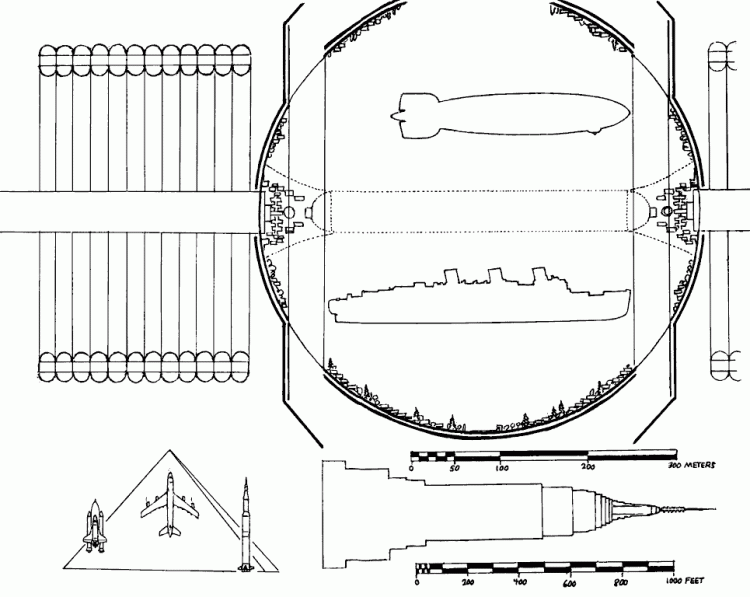
“RealSpace” is a likely third term designating a set of definitions arguing against “NoSpace.” The fourth term describes the results of OldSpace and NewSpace efforts since Apollo. The first RealSpace definition moves the boundary of “space” from the present Karman line altitude of 62 miles to Geostationary Earth Orbit (GEO) at 22,236 miles. The second definition classifies space platforms and spacecraft as essentially different constructs than space stations and spaceships. A “space station” is properly a minimum-healthy-cubic-foot-per-person compartment providing a near-sea-level radiation environment and artificial Earth gravity Beyond Low Earth Orbit (BLEO). Mating a propulsion system to a large enough station would in effect make it a “spaceship” capable of interplanetary travel Beyond Earth and Lunar Orbit (BELO).
The third RealSpace definition regards space “travel” as necessarily a BLEO/BELO activity. Due to the distances involved, exploring the solar system with humans will require nuclear energy, multi-year missions, and spaceships of a size that, at this point, provoke shock and automatic denial. Due to the radiation problem any long term human presence BLEO will require massive shielding realistically well over one thousand tons for even a small crew. Again, this seemingly impossible requirement provokes shock and automatic denial. Especially outraged are NewSpace enthusiasts whose entrepreneurial visions do not include massively shielded, state sponsored projects. Space travel in the cislunar sea between the Moon and Earth is a risky activity using spacecraft without adequate shielding and must eventually end when true spaceships become available.
A basic guide to the requirements for any RealSpace activity can be gathered from three sources; the magazine article by Eugene Parker “Shielding Space Travelers”, the book “Project Orion, the true story of the atomic spaceship” by George Dyson, and the work of Paul Spudis that half a decade ago revealed the ice resources at the lunar poles. This “Parker-Dyson-Spudis continuum” is the key to any real progress in space exploration and colonization. In 1976 “The High Frontier” by Gerard Kitchen O’Neill was published and this book proposed artificial hollow spinning moons constructed from lunar material as the only practical form of space colonization. O’Neill’s conclusion that no natural bodies in the solar system are suitable for colonization still holds true. Space solar energy was also proposed in this work as the economic driver of colonization and, 40 years ago, the cure for global warming.
The present zeitgeist is to accept the media’s portrayal of LEO and Mars as the “logical” goals of U.S. and international space efforts. NewSpace marketing and NASA public relations are largely responsible for this farce and reversing those effects are a critical first step. The best course would be to abandon both the LEO and Mars dead ends and focus exclusively on lunar resources and Super Heavy Lift Vehicles. Entrepreneurial efforts presently directed at reuse by landing back the lower stages of smaller vehicles would best be redirected into lunar lander development. Unless the next U.S. administration drives change, OldSpace and NewSpace will continue to generate NoSpace for decades to come. The U.S. DOD budget is proof that America has the resources necessary to change direction and begin a second space age without end.


The NewSpace Flim Flam

Infographic source: http://arxiv.org/ftp/arxiv/papers/1410/1410.6865.pdf

By Gary Michael Church

The recent 15 year “celebration” of the ISS drove me to comment on a certain forum and once again, I have been banned. I have been persona non grata on all of the popular space websites for several years now.

The ISS is the “jobs program” the NewSpace mob is always screaming at the top of their lungs about. It is a statement about how stupid they think the public is that the jobs program they wail and gnash their teeth about is actually their own sacred cash cow. Without the ISS there would be no SpaceX or NewSpace. The Flim Flam trapping the U.S. in LEO is made clear by the infographic at the top of the page which explains the energy required to lift radiation shielding from the surface of the Moon to GEO.

The present situation concerning space travel is this- there is only one place to go and that destination is the Moon. LEO is not really space, it is basically a 3 hour drive straight up. The real edge of space is GEO, 23,236 miles up. The radiation environment above LEO in real space means no extended human presence is possible without massive shielding. Short of lifting thousands of tons of plastic or tapwater out of the deep gravity well of Earth, the only place offering a radiation sanctuary is the Moon.

There are actually immense lava tubes that a small city could fit in theorized to exist under the surface of the Moon. Unfortunately, while we have spent billions on science probes to every planet in the solar system (and the space station to nowhere) we do not know where these ready made sanctuaries are in our own back yard. Human beings can dash across the quarter-million-mile-wide cislunar sea between Earth and the Moon but if they get caught in a solar particle event, a “storm”, they will suffer profound life-shortening or fatal radiation exposure.

Robots can possibly create a sanctuary in lunar orbit by way of robot ice harvesters that land on ice deposits and ferry water up to empty rocket stages. When these stages are partially filled with several hundred tons of water they become a radiation sanctuary. Attach a cable system between two such stages and spin them and an Earth gravity and near-sea-level radiation environment exists where a human being can survive indefinitely with no ill effects. These true space stations should be the bare minimum result of several hundred billion dollars and decades of investment. It follows such stations are the precursors to any true spaceships.

Beyond Earth and Lunar Orbit (BELO) any human missions will require a several thousand ton water-filled spinning construct and for pushing such a conveyance around the solar system chemical propulsion is essentially useless. Only nuclear energy will work and LEO is the worst place to acquire shielding, assemble, test, and launch any such nuclear mission. To go anywhere we must go to the Moon first.

LEO and Mars are a dead end on one hand and an impractical fantasy on the other; the only path to space is the Moon and that is not “flexible.”

Lunarville

image: National Geographic voices

FAA's Nield Endorses Woerner's Moon Village, But With Commercial Partners Too

The rest of the planet is ready to go to the Moon but due to a years ago campaign contribution from an internet entrepreneur it appears the U.S. will have to be dragged kicking and screaming. When an FAA official makes the President’s official policy look stupid…..What’s next?

Perhaps revisiting some questions posed by a past study:

“Key Questions to Guide the Plan for Human Spaceflight-
The Committee identified the following questions that, if answered, would form the basis of a plan for U.S. human spaceflight:

1. What should be the future of the Space Shuttle?
2. What should be the future of the International Space Station (ISS)?
3. On what should the next heavy-lift launch vehicle be based?
4. How should crews be carried to low-Earth orbit?
5. What is the most practicable strategy for exploration beyond low-Earth orbit?

The Committee considers the framing and answering of these questions
individually, and in a consistent way, to be at least as important as their combinations in the integrated options for a human spaceflight program.”

Yes, it was definitely the framing that mattered most in my view.

1. The future of the shuttle should have been a cargo version without the orbiter. From day one. A key failure, perhaps THE key failure of the entire shuttle program. This failure was compounded into a complete disaster for Human Space Flight when the Sidemount option was rejected.

2. The future of the ISS should have been to decommission it as soon as practical. There was and is nothing more to learn after decades of LEO space stations. It goes around and around a couple hundred miles up and eats billions of tax dollars a year for no result. LEO is a dead end. Space really begins at GEO, 22,236 miles up.

3. The next Heavy Lift Vehicle should have started with developing reusable pressure-fed boosters as originally proposed for the shuttle. The less attractive option was to continue development of the SRB’s with the 5 segment version. Yet another failure.

4. Crews should NOT be carried to LEO but should instead go directly to a radiation sanctuary in orbit around the Moon, eventually under the surface of the Moon, and ultimately to a GEO sanctuary to await transfer to a fully shielded cislunar ferry (an Aldrin cycler). There was never any point in having people in LEO after Apollo 8. No point at all.

5. The ONLY “practical strategy” for Beyond Earth Orbit exploration was to acquire space radiation shielding from lunar ice, assemble, test, and launch nuclear propelled true spaceships from outside the Earth’s magnetosphere- from the Moon. Both LEO and Mars are non-starters. The Moon is the only path to space and that is not flexible.

NewSpace proponents have completely misled and misinformed the public concerning the realities of spaceflight.