Letter to Marcia Smith

Since she will not post any more of my comments on Space Policy Online, I will just have to post them here. In response to http://www.spacepolicyonline.com/news/bridenstine-releases-american-space-renaissance-act-welcomes-comment

We will either choose to establish humans in space- to expand humankind off world- or we won’t. That is the choice and everything revolves around choosing to do so or playing games that dance around a lack of resolve.

Radiation is square one. Massive shielding is the elephant in the room and the only place to get it is the lunar poles. The only way to dip this water out of the shallow lunar gravity well is to start a new 30 year program of Super Heavy Lift Vehicle launches as the successor to the shuttle. That would be the SLS.

Abandoning the dead end of LEO and Mars is the only logical course. If NewSpace wants to redirect their efforts into lunar landers that will be fine. If they want to continue to pursue their LEO tourist empire fantasy then they will continue to be the worst thing that has ever happened to space exploration.

Dr. Spudis has returned to the blogsphere after a short absence and I have posted several comments on his latest post:http://www.spudislunarresources.com/blog/2016-columbia-medal-of-the-american-society-of-civil-engineers/

Your comment is awaiting moderation.

The video was excellent except for the fuel depot nonsense at 16:30.

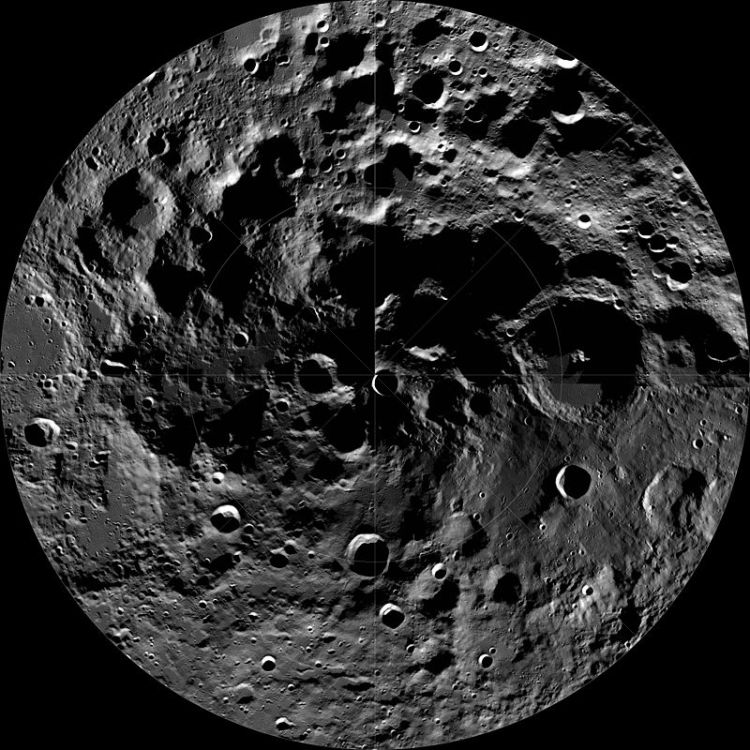
4:00 Whipple and Shackleton anomalous craters almost certainly contain ice and have almost constant solar energy exposure. These two places at the poles should be the focus of all space exploration advocates. These lunar resources are the gateway to the solar system. The first 5 minutes of the presentation make NewSpace efforts look like the bored billionaire hobby projects they are.

11:00 The use of water as an energy storage medium using solar energy and fuel cells, as radiation shielding, and as rocket fuel was explained really well. Radiation shielding is my main concern and getting that water into lunar polar “frozen” orbit and into wet workshops in my view the critical step in building true space stations and eventually spaceships.

13:00 Radiation is square one. Robot landers to harvest ice and volatiles and shuttle water shielding into lunar orbit is the quickest way to establish a permanent human presence Beyond Earth Orbit. The ice on the Moon is THE critical resource for Human Space Flight. An understanding that LEO is not really space is what is needed for the public to support space exploration.

13:50 “Combined together in some future heavy lift vehicle” being the SLS of course. There really is no substitute for sending a Super Heavy Lift Vehicle to the Moon 6 to 8 times a year in the same way we sent the Shuttle into LEO for 30 years. Abandoning LEO and Mars and focusing exclusively on lunar resources is the only path that makes any sense at all.

14:50 The volatiles in the ice is important not only for industrial processes to make fuel (in my view methane is a more appropriate propellant than hydrogen for initial production) but also for…agriculture. An independent human colony will have to grow it’s own food of course.

17:00 and 18:00- Sending the iterations of the SLS to the Moon for the next 30 years like we sent the Shuttle into LEO is really the only option in my view. Future iterations would use pressure fed ocean recovered boosters and send empty upper stage wet workshops into lunar orbit. These workshops would be used first as “long duration” human crewed GEO space stations and eventually with nuclear propulsion systems as true spaceships.

http://www.denverpost.com/business/ci_29772777/nasa-getting-closer-boots-mars-colorado-companies-help

“Newman said that after 15 years of work on the International Space Station, and with all the research and technology development, NASA is well on its way to helping humanity become interplanetary.”

The Deputy Administrator is pushing the same old Mars/LEO dead end that has trapped humanity in Earth Orbit since 1972. The monumental wrong turn was retreating from the Moon and the only salvation is turning our eyes back on that prize.

From Marco Caceres, senior analyst and director of space studies for Teal Group Corp., a provider of aerospace and defense market analysis:
“Now you’re seeing private industry dominate the headlines. At some point, the public starts to wonder, ‘What is NASA good for again?’ ”

Something has to happen to get the U.S. space program off this road to failure. I am hoping Dr. Spudis’ book will be a wake up call to the public. The last book about space to really make an impression on the citizenry was “The High Frontier” by Gerard K. O’Neill in 1976.
Almost completely forgotten now.

https://www.flightglobal.com/news/articles/moon-or-mars-lockheed-preps-orion-for-deep-space-ad-424203

It was always obvious to me the SLS is a Moon rocket. As it gets closer to flying the NewSpace crowd is going to go nuts- it is the single most serious threat to their LEO tourist empire fantasy.

Hopefully Dr. Spudis’ book will help expose the whole ridiculous mess.

http://www.forbes.com/sites/brucedorminey/2016/03/24/china-likely-to-beat-nasa-back-to-the-moon/#66f03fac604c

30,000 views of this story so hopefully more articles will flood the media after the book comes out. The problem of course will be the NewSpace mob playing their standard disgusting game. The comment by Boozer really made me mad.

So sick of them. At this point they believe the barge landing has given them the last word with the public and that everybody believes their scam without question. No criticism of NewSpace, the flagship company, or the demi-god is allowed anywhere (except here).

RealSpace or NoSpace

RealSpace or NoSpace

By Gary Michael Church

The 1967 Apollo 1 fire was the key event leading to the end of the 1st space age before it really began. Anticipation by the aerospace industry of astronomical profits came to an abrupt end in one afternoon. It was not the three fatalities that doomed the space age, as aviation mishaps every year before and since result in hundreds of civilian deaths. The realization that space was going to be hard money would be the catalyst that shifted the focus of industry. The problem was that cold war toys generating vast revenues did not really have to perform as required and spaceships had to work as advertised. Concerning Human Space Flight, there are no false promises or rigged tests bringing in money because actual space travel cannot be faked. Industry chose the easy defense money. Despite recent public relations efforts proclaiming a new age of cheap lift the reality has not changed.

There is no cheap.

At the end of 1968, 22 months after Apollo 1, Apollo 8 left the gravitational field of Earth. Human beings left Earth orbit on December 21st to orbit the Moon and the space age began. Four years later the space age ended when Apollo 17 splashed down on December 19, 1972. The Apollo 8 mission lasted six days, Apollo 10 eight days, Apollo 11 another eight days, Apollo 12 ten days, Apollo 13 five days, Apollo 14 nine days, Apollo 15 twelve days, Apollo 16 eleven days, and Apollo 17 twelve days- for a total of 83 days. Those nine missions over four years totaling a week short of three months Beyond Earth Orbit were the space age. Very soon a half a century will have passed since human beings left Earth. A repeat of the Apollo 8 mission is tentatively scheduled for 2023 but the future of the under-funded and highly criticized Space Launch System is in doubt. These SLS critics are almost all NewSpace fans with an Ayn-Rand-in-Space libertarian worldview.
The current circumstances surrounding Human Space Flight are complex and addressing the situation beyond the scope of an opinion column. However, some progress may be made by clarifying the terminology involved in discussing space. Such conversations are often a confusing mess due to years of the relevant terms being used ambiguously in misleading infomercials. Revised definitions are a must-have for sorting out exactly what is happening.  OldSpace is used disparagingly to describe the aerospace “giants” that have passed on public works projects in space in favor of defense dollars. NewSpace is used to signify  entrepreneurial efforts to make space pay-off for private investors by way of “cheap lift” that outbids supposedly corrupt aerospace concerns. These two descriptors are often disputed or modified so transcending and clarifying with a third and fourth are in order.
“RealSpace” is a likely third term designating a set of definitions arguing against “NoSpace.” The fourth term describes the results of OldSpace and NewSpace efforts since Apollo. The first RealSpace definition moves the boundary of “space” from the present Karman line altitude of 62 miles to Geostationary Earth Orbit (GEO) at 22,236 miles. The second definition classifies space platforms and spacecraft as essentially different constructs than space stations and spaceships. A “space station” is properly a minimum-healthy-cubic-foot-per-person compartment providing a near-sea-level radiation environment and artificial Earth gravity Beyond Low Earth Orbit (BLEO). Mating a propulsion system to a large enough station would in effect make it a “spaceship” capable of interplanetary travel Beyond Earth and Lunar Orbit (BELO).
The third RealSpace definition regards space “travel” as necessarily a BLEO/BELO activity. Due to the distances involved, exploring the solar system with humans will require nuclear energy, multi-year missions, and spaceships of a size that, at this point, provoke shock and automatic denial. Due to the radiation problem any long term human presence BLEO will require massive shielding realistically well over one thousand tons for even a small crew. Again, this seemingly impossible requirement provokes shock and automatic denial. Especially outraged are NewSpace enthusiasts whose entrepreneurial visions do not include massively shielded, state sponsored projects. Space travel in the cislunar sea between the Moon and Earth is a risky activity using spacecraft without adequate shielding and must eventually end when true spaceships become available.
A basic guide to the requirements for any RealSpace activity can be gathered from three sources; the magazine article by Eugene Parker “Shielding Space Travelers”, the book “Project Orion, the true story of the atomic spaceship” by George Dyson, and the work of Paul Spudis that half a decade ago revealed the ice resources at the lunar poles. This “Parker-Dyson-Spudis continuum” is the key to any real progress in space exploration and colonization. In 1976 “The High Frontier” by Gerard Kitchen O’Neill was published and this book proposed artificial hollow spinning moons constructed from lunar material as the only practical form of space colonization. O’Neill’s conclusion that no natural bodies in the solar system are suitable for colonization still holds true. Space solar energy was also proposed in this work as the economic driver of colonization and, 40 years ago, the cure for global warming.
The present zeitgeist is to accept the media’s portrayal of LEO and Mars as the “logical” goals of U.S. and international space efforts. NewSpace marketing and NASA public relations are largely responsible for this farce and reversing those effects are a critical first step. The best course would be to abandon both the LEO and Mars dead ends and focus exclusively on lunar resources and Super Heavy Lift Vehicles. Entrepreneurial efforts presently directed at reuse by landing back the lower stages of smaller vehicles would best be redirected into lunar lander development. Unless the next U.S. administration drives change, OldSpace and NewSpace will continue to generate NoSpace for decades to come. The U.S. DOD budget is proof that America has the resources necessary to change direction and begin a second space age without end.


The NewSpace Flim Flam

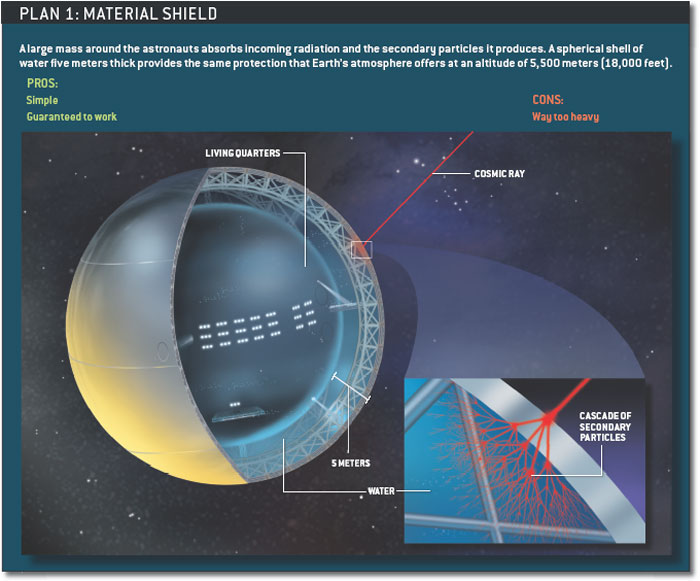
Infographic source: http://arxiv.org/ftp/arxiv/papers/1410/1410.6865.pdf

By Gary Michael Church

The recent 15 year “celebration” of the ISS drove me to comment on a certain forum and once again, I have been banned. I have been persona non grata on all of the popular space websites for several years now.

The ISS is the “jobs program” the NewSpace mob is always screaming at the top of their lungs about. It is a statement about how stupid they think the public is that the jobs program they wail and gnash their teeth about is actually their own sacred cash cow. Without the ISS there would be no SpaceX or NewSpace. The Flim Flam trapping the U.S. in LEO is made clear by the infographic at the top of the page which explains the energy required to lift radiation shielding from the surface of the Moon to GEO.

The present situation concerning space travel is this- there is only one place to go and that destination is the Moon. LEO is not really space, it is basically a 3 hour drive straight up. The real edge of space is GEO, 23,236 miles up. The radiation environment above LEO in real space means no extended human presence is possible without massive shielding. Short of lifting thousands of tons of plastic or tapwater out of the deep gravity well of Earth, the only place offering a radiation sanctuary is the Moon.

There are actually immense lava tubes that a small city could fit in theorized to exist under the surface of the Moon. Unfortunately, while we have spent billions on science probes to every planet in the solar system (and the space station to nowhere) we do not know where these ready made sanctuaries are in our own back yard. Human beings can dash across the quarter-million-mile-wide cislunar sea between Earth and the Moon but if they get caught in a solar particle event, a “storm”, they will suffer profound life-shortening or fatal radiation exposure.

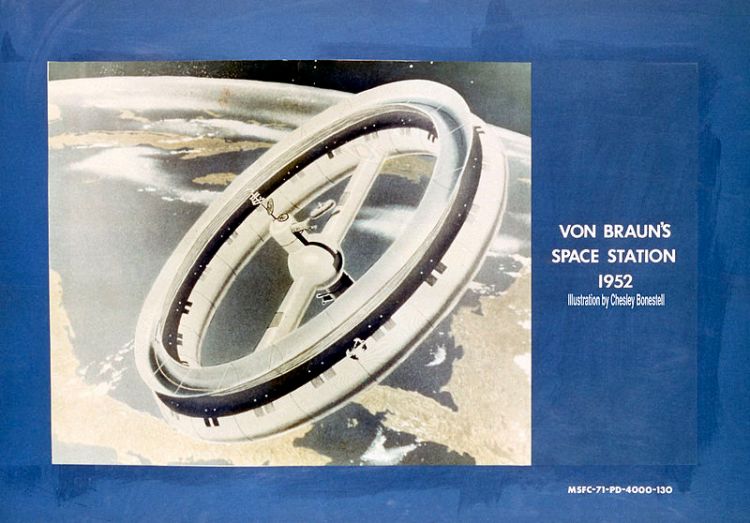
Robots can possibly create a sanctuary in lunar orbit by way of robot ice harvesters that land on ice deposits and ferry water up to empty rocket stages. When these stages are partially filled with several hundred tons of water they become a radiation sanctuary. Attach a cable system between two such stages and spin them and an Earth gravity and near-sea-level radiation environment exists where a human being can survive indefinitely with no ill effects. These true space stations should be the bare minimum result of several hundred billion dollars and decades of investment. It follows such stations are the precursors to any true spaceships.

Beyond Earth and Lunar Orbit (BELO) any human missions will require a several thousand ton water-filled spinning construct and for pushing such a conveyance around the solar system chemical propulsion is essentially useless. Only nuclear energy will work and LEO is the worst place to acquire shielding, assemble, test, and launch any such nuclear mission. To go anywhere we must go to the Moon first.

LEO and Mars are a dead end on one hand and an impractical fantasy on the other; the only path to space is the Moon and that is not “flexible.”

Lunarville

image: National Geographic voices

FAA's Nield Endorses Woerner's Moon Village, But With Commercial Partners Too

The rest of the planet is ready to go to the Moon but due to a years ago campaign contribution from an internet entrepreneur it appears the U.S. will have to be dragged kicking and screaming. When an FAA official makes the President’s official policy look stupid…..What’s next?

Perhaps revisiting some questions posed by a past study:

“Key Questions to Guide the Plan for Human Spaceflight-
The Committee identified the following questions that, if answered, would form the basis of a plan for U.S. human spaceflight:

1. What should be the future of the Space Shuttle?
2. What should be the future of the International Space Station (ISS)?
3. On what should the next heavy-lift launch vehicle be based?
4. How should crews be carried to low-Earth orbit?
5. What is the most practicable strategy for exploration beyond low-Earth orbit?

The Committee considers the framing and answering of these questions
individually, and in a consistent way, to be at least as important as their combinations in the integrated options for a human spaceflight program.”

Yes, it was definitely the framing that mattered most in my view.

1. The future of the shuttle should have been a cargo version without the orbiter. From day one. A key failure, perhaps THE key failure of the entire shuttle program. This failure was compounded into a complete disaster for Human Space Flight when the Sidemount option was rejected.

2. The future of the ISS should have been to decommission it as soon as practical. There was and is nothing more to learn after decades of LEO space stations. It goes around and around a couple hundred miles up and eats billions of tax dollars a year for no result. LEO is a dead end. Space really begins at GEO, 22,236 miles up.

3. The next Heavy Lift Vehicle should have started with developing reusable pressure-fed boosters as originally proposed for the shuttle. The less attractive option was to continue development of the SRB’s with the 5 segment version. Yet another failure.

4. Crews should NOT be carried to LEO but should instead go directly to a radiation sanctuary in orbit around the Moon, eventually under the surface of the Moon, and ultimately to a GEO sanctuary to await transfer to a fully shielded cislunar ferry (an Aldrin cycler). There was never any point in having people in LEO after Apollo 8. No point at all.

5. The ONLY “practical strategy” for Beyond Earth Orbit exploration was to acquire space radiation shielding from lunar ice, assemble, test, and launch nuclear propelled true spaceships from outside the Earth’s magnetosphere- from the Moon. Both LEO and Mars are non-starters. The Moon is the only path to space and that is not flexible.

NewSpace proponents have completely misled and misinformed the public concerning the realities of spaceflight.

One Trillion Dollars

image: britannica.com

http://fortune.com/2015/08/14/f-35-joint-strike-fighter/

Thank you Norm Augustine for giving us this piece of junk instead of a base on the Moon. And to continue the earlier letter to Paul:
October 21, 2015 at 10:54 am

http://www.sciencedaily.com/releases/2015/10/151020192331.htm

At the beginning of the year I commented on a fairly well known blog about the danger of an asteroid or comet impact- specifically, I completely disagreed with the author who was trivializing the danger. There were of course several wishy-washy waffle statements in the article so he could plead not guilty but it was obvious he was portraying it all as a joke. He answered my arguments with a string of replies that were increasingly hostile and insulting until perhaps he realized that was not such a good idea and deleted the entire conversation. http://www.wired.com/2015/01/fun-flaming-death/

Two weeks later came the Chelyabinsk event.

image: Youtube
image: Youtube

Said author column has since been discontinued but I doubt his “fun with flaming death” article had anything to do with that. Many of the so-called experts who write popular science columns are among the worst liars and deceivers in popular culture media. The almost unanimous support for NewSpace and the flexible path among this bunch of charlatans shows they do not take their profession or integrity as journalists seriously.

Another letter to Paul

October 20, 2015 at 8:05 am

image at wikipedia; meteor impact

“It is difficult for people to envision the immensity of geologic time, as they tend to reckon time spans in relation to their own lives.” Excerpt from Paul Spudis’ article on Smithsonian site.

My own theory is that it is difficult for people to make any decision that does not immediately benefit them. We all know subconsciously we are going to die so most of our thinking is based on getting what we can before that happens- and not much else matters. I used to be skeptical about such subconscious devices until my own participation in rescue missions came back to haunt me.

We take it for granted this world is the way it should be because it is. When someone says the chances of the Earth getting hit by a large comet or asteroid in our lifetime is “astronomically low” then we accept that as not worth any more attention. It is not “we” that say this, it is “I” that reasons I will be dead so it does not matter. And so biological life may be too stupid to survive.

But as Dr. Spudis has done here, if we had lives that stretched across geological time, an indefinite lifespan, then our reasoning would be much different. This is actually not so hard to imagine when star travel is taken into account. The present most plausible method of traveling to another solar system is the “sleeper ship.” In this scenario our bodies are frozen with a process that does not damage cells and the temperature lowered to close to absolute zero. The Starship is propelled to a few percent of the speed of light, probably with a tremendous beam of energy. After a voyage lasting several centuries or even thousands of years, upon arrival the ship slows down, probably using H-bombs, and the crew is revived. The alien solar system is explored and the Starship begins the return voyage. When the crew arrives they have aged perhaps ten years while centuries or millennia have passed on Earth. It would be a reasonable assumption for the crew that while they were frozen a cure for old age would be found.

The people on a Starship would be far more concerned about the future than we are. In some modest lab on planet Earth somewhere a dog or monkey may wake up tomorrow after being frozen- with no ill effects- and then what I just wrote will matter.

Luna 27 and U.S. Failure

http://www.bbc.com/news/science-environment-34554517

The rest of the world is going to the Moon while we launch exploding hobby rockets and cheer for Matt Damon. The nation that built the Saturn V has to pay Russians hundreds of millions of tax dollars for a ride to the space station to nowhere that took over ten years and 100 billion U.S. tax dollars to build. The nation whose space agency is fighting with congress over funding the only Beyond Earth Orbit spacecraft being built (the space agency wants the hobby rocket instead). The nation that spends such a mind boggling sum on defense that billions disappear without a trace and nobody seems to question this- yet cannot build a rocket that takes astronauts even into the space-that-is-not-really-space of Low Earth Orbit.

The ice on the Moon is the critical enabling resource for any human expansion beyond Earth orbit. Yet because of the years ago campaign contribution from an internet billionaire who has made himself the invisible head of NASA, discussion of the Moon is….verboten.

Image: NASA
Image: NASA

Spaceships

Spaceship in full shock
Spaceship in full recoil

Spaceship ready for powered flightSpaceship transitioning to artificial gravityEngine Section seperated from Crew SectionCrew Section separated from Engine SectionSpaceship in Artificial Gravity Mode print

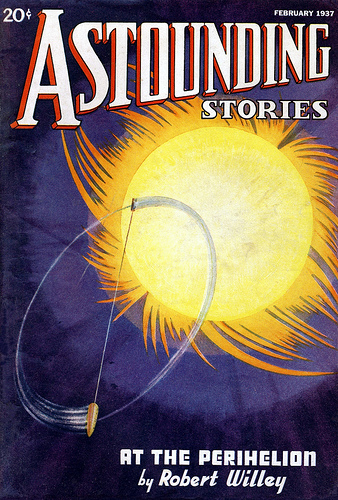
Spaceship in Artificial Gravity Mode1astounding stories feb 1937

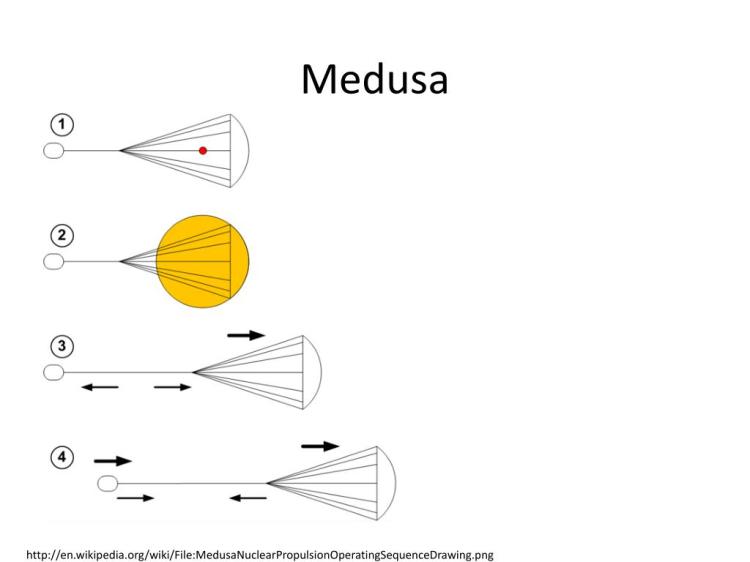
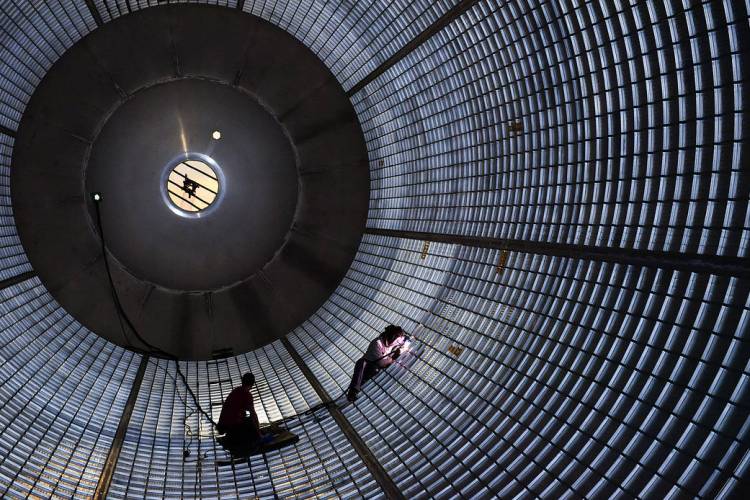
Most Americans are familiar with water towers and these towers are fascinating examples of the necessary minimum dimensions of what could be called a “true” spaceship. The definition of a true spaceship is a craft that can carry human beings on interplanetary journeys while providing an Earth gravity/radiation environment. The last part is what determines most of everything else- radiation is square one. As Eugene Parker has stated in his articles concerning the heavy nuclei component of galactic cosmic radiation, the only guaranteed solution to shielding space travelers is mass and distance. Mass on the order of 500 tons and a distance of about 15 feet- with water being the most utilitarian shielding material. Since this figure would protect only a minimum crew area the size of a small capsule, for long duration missions the psychological space necessary for mental health equates to a realistic shield way over 1000 tons. To push such a shield around the solar system at a speed that will allow missions to the gas and ice giants lasting 3 to 5 years only one form of propulsion is practical: H-bombs.

The two most difficult challenges when using nuclear pulse propulsion are first the scale required for an efficient engine and then where it can be fired. The “engine” used in pulse propulsion is essentially a metal disc massing a minimum of several thousand tons. The reason for the over one hundred foot diameter disc is the difficulty in building a small enough bomb to be efficient. The larger the disc, the larger the bomb that can be used and since H-bombs all use a standard amount of fissionable material with small amounts of tritium and deuterium added for the fusion reaction, pulse propulsion efficiency increases with size. As the disc approaches a thousand feet in diameter the Isp numbers soar into the tens of thousands. Lighting off H-bombs in the Earth’s magnetosphere results in fission byproducts being sucked down into the atmosphere and since this sphere extends almost to the Moon, the Moon is the jumping off point for interplanetary travel.

The remaining question is how to acquire the plate. The shielding can be had by way of lunar ice but bringing the disc up from Earth is problematic. Fabricating the engine from lunar titanium would be ideal but requires a factory. Giant lava tubes are theorized to exist beneath the surface of the Moon and these could serve as factory floors. An underground lunar factory with several hundred workers does not seem to be a possibility in this half of the century. The prerequisite is a Super Heavy Lift Vehicle much larger than the current SLS and flying at a rate the shuttle only aspired to (just before Challenger the shuttle had 15 launches planned over the following year of operations). These SHLV’s would probably have reusable pressure fed boosters (originally proposed for the shuttle) and would also most likely fly the main engine module around the Moon on a free return back to Earth reentry and also be recovered at sea.

If a lava tube site was found and after about a ten year development period this proposed SHLV could fly around ten missions a year for the next ten years at the end of these two decades a factory capable of producing pulse propulsion discs several hundred feet in diameter might be ready to start up. The first of a fleet of lunar production spaceships is a possibility by the year 2040. Perhaps even before my eightieth birthday. By 2040 there should be a dozen or so crewed wheels in GEO providing telecom services. The questions that arise concerning this move into space are what kind of ship can serve as an interim to move the nuclear arsenal into deep space in the decades before lunar production begins? There is also the ultimate goal of Space Solar Power satellites and Bernal Spheres which will be the focus of the second half of the 21st century.

News Items

http://motherboard.vice.com/en_uk/read/how-blowing-massive-polymer-bubbles-could-help-us-build-structures-in-space

Bernal Spheres are on the way.

http://www.dailygalaxy.com/my_weblog/2015/10/mit-a-manned-mission-to-mars-may-require-a-detour-to-the-moon.html

Yes, some have known this since the ice on the Moon was discovered.

http://www.theatlantic.com/science/archive/2015/10/the-most-interesting-star-in-our-galaxy/410023/

The most interesting item I have seen in many, many years. Most people cannot wrap their heads around it.