Having landed on the Moon a half century ago we should have fleets of spaceships traveling the solar system by now. You would think. The reality is the public does not understand what would define a true spaceship. Though I have always disliked similes concerning space, especially those like JFK’s calling space an ocean, it has some utility.
- A spaceship, like a ship on the ocean, must be capable of crossing an ocean. The space analogy of a small ocean, like the Mediterranean, might be from the Earth to Mars. The Pacific analogy might be Pluto. The analogy to oceanic storms would be radiation and the equivalent to running aground would be meteorite damage.
- The basic requirement to travel interplanetary space, that is, Human Spaceflight Beyond Earth and Lunar Orbit (HSF-BELO), is to weather space storms. If radiation is the equivalent of an ocean storm it is interesting that taking a microcosm of an ocean into space as a kiloton+ cosmic radiation shield seems to be the prerequisite.
- The next requirement for HSF-BELO is speed. It relates directly to the first problem because though 400 tons are needed to shield a small capsule, humans have psychological limits concerning living space and mission time which equates to thousands of tons of water. And pushing those kilotons requires nuclear energy. There is only one practical nuclear propulsion system: Bombs.
- Along with dosing there is long term microgravity debilitation which will require tether generated artificial gravity. Micrometeorite shielding will require more mass and a warning and deflection system for larger particles. The unavoidable mass penalty for multi-year HSF-BELO missions is going to be ten thousand tons plus.
- A “true spaceship”, versus a spacecraft, would likely mass well over ten thousand tons minimum, carrying a couple thousand nuclear bombs, at least a thousand tons of water for cosmic ray shielding, using either a metal disc or a parachute of some kind as an engine. Water would be acquired from, and assembly and testing would be done on, or in the vicinity of, the Moon.
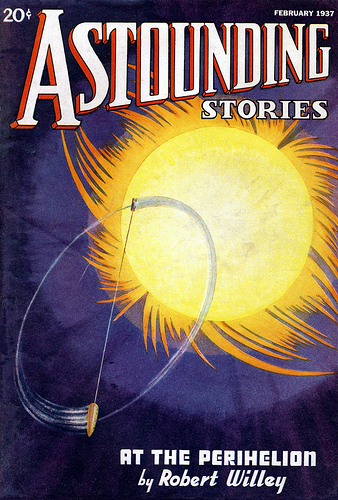
- On multi-year missions the true spaceship would spend most of the time split in half with equal or spaced masses spinning at the end of a several thousand foot tether system. The larger the disc (or “spinnaker” in a Medusa type) the more efficient, faster, and longer ranged, likely operating between Ceres and Neptune.
- Relocating the superpower nuclear arsenals into deep space to ratchet down the cold war launch-on-warning situation is perhaps the only enabler for HSF-BEO. Fleets of such “space boomers” would also protect Earth from impact threats and allow for guest scientists on voyages of exploration to the gas and ice giants.
 Ice on the Moon