The First Space Boomer

By Gary Michael Church
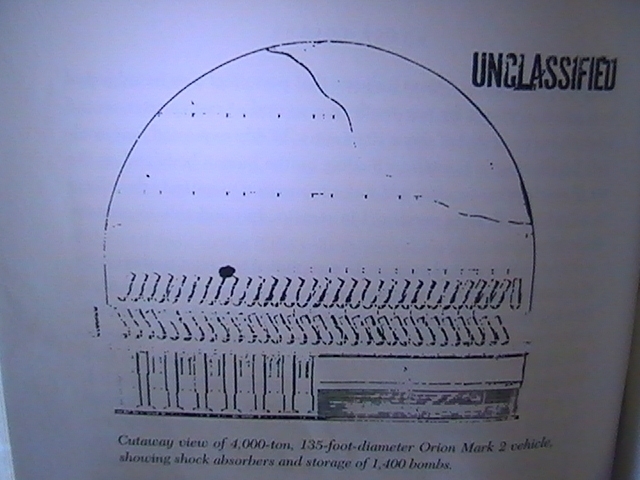
Orion Mark 2

From: Project Orion, the true story of the atomic spaceship, by George Dyson


Few people today could tell you what the “41 for Freedom” were. In the late 1950’s the DOD worried over the Soviet Union destroying the U.S. strategic deterrent of nuclear weapons in a “first strike.” Missiles in silos in the Midwest and the majority of the nuclear bomber fleet at airbases were considered vulnerable to being destroyed in a future preemptive launch by the adversary. The solution was a fleet of 41 nuclear submarines loaded with Polaris nuclear missiles. A force of these “boomers” was to be kept at sea and hidden in the depths of the ocean, immune to any first strike.

From wiki: “George Washington left Groton on 28 June 1960 for Cape Canaveral, Florida, where she loaded two Polaris missiles. Standing out into the Atlantic Missile Test Range – she successfully conducted the first Polaris missile launch from a submerged submarine on 20 July 1960.”

Missile Submarines went to sea shortly before I was born. Now, over 60 years later, I am an old man and have lived my whole life with the constant threat of nuclear weapons minutes away from being launched and incinerating millions of human beings. Mutually Assured Destruction (MAD) has kept the world at peace for over half a century, preventing any third world war from breaking out. The price paid for that peace has been an incredible amount of money. The cost of the cold war was mind boggling and trillions of dollars continue to be spent. Eisenhower famously spoke about what could be accomplished for the cost of various cold war toys. However, the worst feature of this peace has not been impoverishment, it has been “launch-on-warning”, which has put civilization at risk every minute of every day for an entire lifetime. The result of a full-scale nuclear exchange has been fairly well worked out: billions would die of starvation, possibly a majority of the human race, caused by, for starters, reduced crop yields from smoke in the atmosphere. The fragile structure of our worldwide distribution system would be wrecked and humanity would enter a new dark age.

A nuclear exchange would not be an extinction-level-event in itself, but it could lead to one in that another event, such as a plague, meteor/comet impact, or super-volcano epic might finish us off. And it goes without saying that a lesser version of any of those could trigger an exchange or destabilize relations and cause a global conflict. A Carrington event solar flare could also lead to a chain reaction resulting in nuclear war and the collapse of civilization. The point being we are in a position right now to direct immense resources at safeguarding civilization. It is no exaggeration to state that a century from now the human population of Earth could be in the process of migrating to space colonies. A century after that Starships carrying frozen humans could be beam-propelled on centuries-long voyages to other stars. These scenarios are what the human race needs to be focused on if we are to survive.

The first step is to begin a second space age using the same device that created the first one: the hydrogen bomb. The dream of removing nuclear weapons from planet Earth can be realized by the superpowers building fleets of Spaceships carrying the bombs months away into deep space. No more launch-on-warning. Not only will the risk of nuclear war ratchet down but a plan to insure humankind survives any natural catastrophes can be put in motion. The same repurposed atomic bombs used to push Spaceships through interplanetary space can be used to deflect asteroid and comet impact threats.

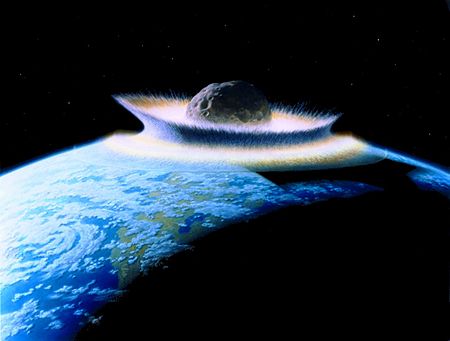
450px-Planetoid_crashing_into_primordial_Earth
image at wikipedia; meteor impact

The first “Space Boomer” could be operational just outside of a decade, much like the first human missions to the Moon were accomplished in that time frame. The main requirements pose no real technical challenges. The trillion plus dollars presently earmarked for new stealth bombers, missile submarines, and generally refurbishing our deterrent can be redirected at space. The sequence would likely begin with a constantly evolving Super Heavy Lift Vehicle (SHLV) program of 6 to 8 launches per year. A basic cislunar infrastructure created for utilizing lunar water for crew compartment shielding would start the assembly pipeline. The first “true” Space Stations and Lunar Cyclers would follow leading to the first “true” Spaceship. This first “Space Boomer” would likely use a “soft” Nuclear Pulse Propulsion system based on the “Medusa” concept.

The “hard” Pulse system will come later. Whether such flying saucers can first be sent up in thin discs or “slices” and assembled and really big multi-thousand ton discs later  manufactured on the Moon is yet to be determined. The first true Spaceships will likely be based on the concept detailed in the 1991 paper “New Ideas for Nuclear Explosive Spacecraft Propulsion” by Johndale C. Solem. Such a spaceship could be assembled and launched from a Earth polar orbit using the first iteration of the SLS and other launch vehicles but this would not be the most efficient way to proceed except as a demonstrator to show the concept is valid. Without a kiloton plus water shield it would not be a “true” Spaceship. Lifting that thousand tons of tap water into Earth orbit would by itself show why the ice on the Moon is the critical enabling resource.

Thus the name of this blog which I started five years ago.


Not a Space Station Joe

I have had writers block since just before the New Year and hopefully this Joe Scott YouTube video has snapped me out of it: https://www.youtube.com/watch?v=ODWq94L0HTs

I posted the following comments on YouTube concerning Joe’s video:

“A “space station” vs an orbital platform would have a cosmic ray water shield and artificial gravity, likely using a tether system to spin wet workshops. The thousand plus tons of water for shielding would also likely be ferried up from the lunar poles by robot landers. This is not what the gateway is and it is not “sustainable” because it won’t shield astronauts or provide artificial gravity.” And then-

“As for your “rationale” of using lunar orbital velocity what you don’t seem to get Joe is that chemical energy is NOT going to send humans anywhere Beyond Earth and Lunar Orbit (BELO). Only nuclear energy will work and there is only one practical nuclear propulsion system- Nuclear Pulse (bombs). Concerning Landers setting down on the Moon to acquire ice these likely robots would be semi-expendable vs reusable. “Reusable” by definition means being able to do maintenance on it between flights. The only place any kind of serious maintenance is going to be done off-world is under the Moon in a pressurized hangar. So, until we move into a lava tube or excavate some kind of base with a pressurized radiation sanctuary anything flying around the cislunar sea is going to just fly till it breaks. See how that works?” And I also posted a link to my October entry about Space Stations vs. Spaceships.

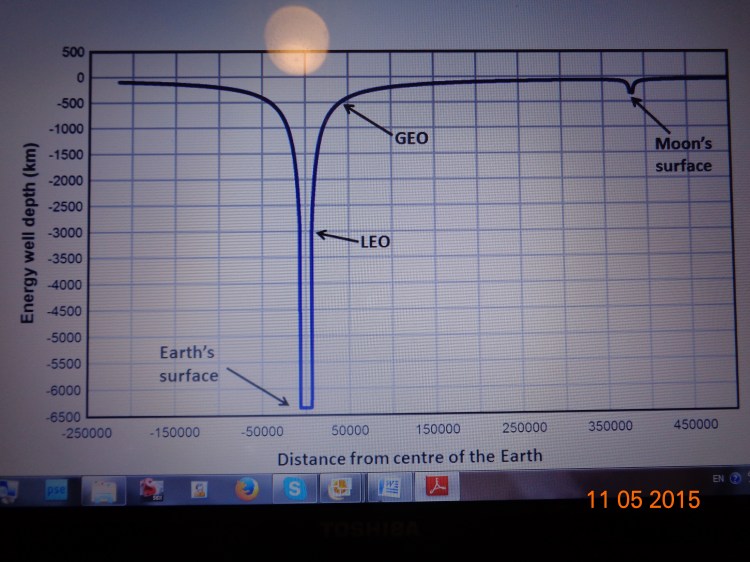
The Parker-Dyson-Spudis Continuum, which I have commented about for years on Dr. Spudis’ blog when he was alive and on other blogs when I was not banned, explains what I hope is the basic problem confronting humankind in regards to any Human Space Flight Beyond Earth and Lunar Orbit (HSF-BELO). That problem is of course that humans require a Near Sea Level Radiation one Gravity (NSLR1G) environment for any long duration deep space missions. According to Eugene Parker, the authority on space radiation, the heavy nuclei component of galactic cosmic radiation requires a massive shield to stop. Water is by far the most utilitarian substance for radiation shielding and can be lifted from the lunar poles with 22 times less energy than from Earth.

Lunar Infographic
Infographic source: http://arxiv.org/ftp/arxiv/papers/1410/1410.6865.pdf

The shielding for any amount of interior space considered livable for multi-year missions would entail a water shield well over a thousand tons for a couple astronauts. From that follows the only propulsion system available for a long time to come that can push such a shield around the solar system at the speeds necessary for a two-way mission to the outer planets which is Nuclear Pulse (bombs). Although this concept originated with Stanislaw Ulam the Original work was done by Freeman Dyson. Last is where to acquire the water shielding, assemble, test and launch such nuclear missions: the vicinity of, or on, the Moon. This was made clear by the work of lunar geologist Paul Spudis.

There are several pieces of critical hardware required for efficiently expanding the human presence into cislunar space and beyond. The first is the Super Heavy Lift Vehicle (SHLV). The SLS is the only such vehicle being offered in my view as the shiny starship is…just another NewSpace gimmick I expect to fail miserably. What the SLS needs to succeed is first a cadence of 6 to 8 flights per year minimum. This could be effected by abandoning Low Earth Orbit (LEO) and redirecting funding into building a second and third SLS core stage production line. All it takes is money. The ISS is a 4 billion dollar a year dead end.

The SHLV 6 to 8 flights a year is a prerequisite- it has to happen for anything else to. Along with the basic way to get there, there is the question of what to send to the vicinity of the Moon and the answer is the building block of a cislunar infrastructure: the wet workshop. Not just a repurposed upper stage but one designed with a double hull utilizing the outer envelope to contain a cosmic ray water shield. This construct would be a “Fat Workshop” of 50 to 60 foot diameter. Sending these Fat Workshops to the Moon with a semi-expendable Robot Lander on top will likely require a 150 ton payload capability.

In my view the best way to enable the necessary 150 ton payload would be to call upon NewSpace to provide replacements for the SLS 5 segment boosters. I propose two lower stages of the New Glenn and a stretched core stage could  launch a 60 foot diameter Fat Workshop with a Robot Lander on top to the Moon.

BlueOrigin_NewGlenn_AftView.png

Sending those Workshop/Lander payloads to the Moon six times a year would be the way to begin. There might also be enough spare payload to allow the SLS RS-25 engine section to reenter with a heat shield as a module and land back for resuse (expending the tank structure). This would essentially be what the Space Shuttle could have been- a way to economically place crew compartments and Landers in the vicinity of the Moon by expending only a large second stage (or core stage) fuel structure.

The semi-expendable Robot Landers would be able to dock with Fat Workshops and move them around and several of the Landers might join together into a composite booster to power Lunar Cyclers. The Cyclers are also on the list of necessary hardware as they would provide radiation shielded transit for astronauts to and from the Moon. This growing list of expensive hardware; triple production lines for stretched SLS core stages, New Glenn 1st stages as replacements for SLS SRB’s, Fat Workshops and Robot Landers, RS-25 re-entry/landing modules, and a fleet of Lunar Cyclers, all this might seem impossible except for the one enabling resource- the DOD.

And I think I am going to describe exactly how to get the DOD to pay for all this next with a separate blog entry. It will start with…Submarines.

170px-USS_Sam_Rayburn_(SSBN-635)_missile_hatches

Image from Wiki


Space Force and NEO’s

galactic patrol

Image by Lucy Wiley https://www.pinterest.com/lucywiley1946/

NASA mission to track near Earth objects takes shape

“This mission would answer a fundamental question: Are there asteroids or comets out there that can cause harm to the Earth over the next century?”

I can answer that question right now. Yes.

The first space age lasted four years and was essentially a cold war battle won by landing on the Moon. The next space age has the potential to once again be about the superpowers and nuclear weapons. The problem is humankind does not seem intelligent enough to make it happen. This could be a showstopper…as in stopping our species dead in its tracks with an extinction level event. The trick is to place thousands of nuclear weapons months away in space on fleets of spaceships and thus remove the hair-trigger-launch-on-warning situation from Earth.

And also defend Earth from comet and asteroid impacts.

And also explore the ocean moons of the gas and ice giants (and Ceres).

And also kick-start the Space Solar Power industry (and space colonization).

Maybe Amy Mainzer could make it happen. If she were to write an Einstein-type letter to the DNC: https://democrats.org/who-we-are/about-the-democratic-party/ recommending the Green New Deal might be best realized as a program to remove all nuclear weapons from Earth and place them in deep space on human-crewed spaceships.

In conclusion, I have written in the past about beam propulsion enabling mass migration to space habitats and I found this recent article worth editing in:

https://www.sciencemag.org/news/2019/12/us-tests-ways-sweep-space-clean-radiation-after-nuclear-attack

-Allison Jaynes, a space physicist at the University of Iowa states, “Besides safeguarding against a nuclear burst, RBR technology could have a civilian dividend, Jaynes notes. NASA and other space agencies have long wrestled with shielding astronauts from the Van Allen belts and other sources of radiation on their way to and from deep space. VLF transmitters might be used to clear out high-energy electrons just before a spacecraft enters a danger zone. “When we become more active space travelers,” she says, “it could provide a safe passage through the radiation belts.”


The List of Errors

By Gary Michael Church

800px-President_Nixon_and_James_Fletcher_Discuss_the_Space_Shuttle_-_GPN-2002-000109

https://www.theatlantic.com/science/archive/2019/12/nasa-boeing-commercial-crew/603970/

The “dramatic error in American spaceflight” is just one more on the list.

  1. The first mistake was not making Project Orion and Nuclear Pulse Propulsion part of the NASA charter in 1958. It must have been obvious even then that lighting off hundreds of bombs in the atmosphere was not practical due to radioactive contamination and the system would likely have to be used well away from Earth orbit. To launch “slices” of the disc used in a pulse propulsion system would require a Nova Class rocket. In 1991 a new approach to Pulse was proposed, the “Medusa” concept, which would make a less efficient Pulse system immediately available.
  2.  The second mistake was not pursuing reusability from the beginning. Philip Bono was the pioneering engineer of the early 1960’s who advocated for Vertical Take-off Vertical Landing (VTVL). This might seem a case of hindsight but in fact VTVL was a recurring theme in science fiction movies and even seen on television shows in the 1950’s such as “Rocky Jones Space Ranger” in early 1954 (1:50). An interesting feature is the obvious massive electrical grid required to launch the “XV2.” A coincidence in regards to the much later concept of beam propulsion. https://www.youtube.com/watch?v=T8Hf-9wHA0I
  3. The third mistake was the limited goal of the Apollo program, to land humans on the Moon and return them, instead of establishing a permanent presence. If that goal had been set as a Moonbase, Apollo would likely have continued to the present day with a constantly evolving family of launch vehicles. The space race was a consequence of the cold war and it is ironic the salient feature of that conflict, the atomic bomb, remains the only enabler for interplanetary travel by humans. Treaties limiting the testing and deployment of nuclear devices crippled any possibility of humans exploring the solar system in the 20th century.

Americans love to glorify NASA and though the amazing work of that agency is now incessantly trivialized and demeaned by NewSpace proponents, the goals set leading up to the first space age were in reality quite limited. Neoliberal contamination was canceling out imbedded liberalism and post war Keynesian economics and this ultimately doomed the first space age to lasting only four short years. The Apollo 1 fire made it clear to aerospace concerns that Human Space Flight Beyond Earth Orbit (HSF-BEO) was going to be hard money and they opted for the easy money of cold war toys.

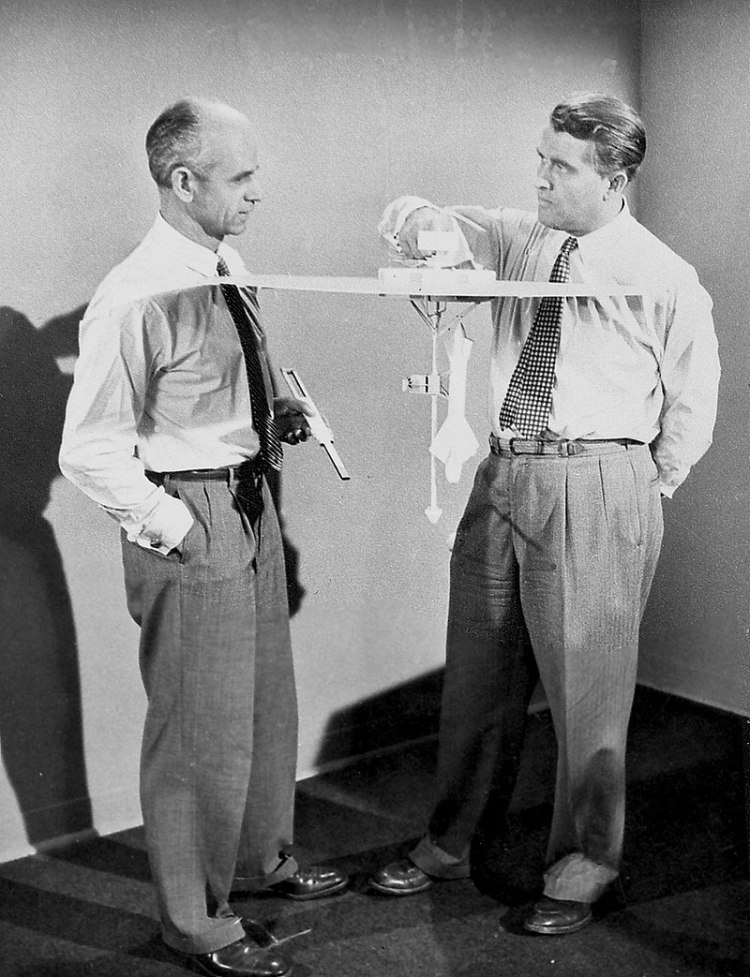
In the mid 50’s and early 60’s it seemed obvious that nuclear energy would be required for Human Space Flight Beyond Earth and Lunar Orbit (HSF-BELO). While chemical energy was appropriate for use in the Earth’s atmosphere and magnetosphere and would serve to enable a cislunar infrastructure, nuclear energy would be required for any human exploration beyond the cislunar sea. https://www.youtube.com/watch?v=8vblN33OJCg
800px-Von_Braun_and_Stuhlinger_discuss_Disney_specialStuhlinger and von Braun from wiki

The 500 foot diameter heat exchanger required for the nuclear electric spaceship concept was interesting in that a similar size solid alloy disc of much greater mass would replace it as the engine of the future. Nuclear Electric and the simpler Nuclear Thermal Rocket (NTR) would both soon be rendered obsolete by the work of Freeman Dyson validating Nuclear Pulse Propulsion. Using what are essentially repurposed nuclear weapons, Pulse still remains the only practical path to a human-crewed true spaceship capable of multi-year voyages of exploration to the outer system.

The test ban treaty of 1963 and outer space treaty of 1967 effectively removed nuclear energy for space propulsion from the zietgeist for over half a century up to the present day. The key technologies regarding nuclear space propulsion were human-rating a Super Heavy Lift Vehicle (SHLV) with a solid fuel escape tower, which allowed fissile materials to be sent into space at acceptable risk, as proven by Apollo. In the 1970’s, as the end of the first space age loomed, a second series of wrong turns were made by the space agency.

In 1971 the Air Force and NASA determined the basic design of the Space Shuttle and a year later Nixon signed off on the program. A decade earlier Philip Bono had advocated for VTVL development but the Shuttle departed from simply landing back stages in the same way they had launched and went with a whole range of very bad design features that would guarantee failure. The catalogue of defects was known and publicized but the show had to go on. http://www.iasa-intl.com/folders/shuttle/GoodbyeColumbia.html

Besides a flawed design the Shuttle’s very purpose was a mistake. Low Earth Orbit (LEO) had been left far behind in 1968 with Apollo 8 and did not really qualify as space exploration or even “space” after that mission. Retreating to a couple hundred miles up after traveling a quarter million miles was a several-orders-of-magnitude-defeat. Sadly, the Space Shuttle had been sold to the public as a space truck that would “pay for itself” when it would ultimately cost close to the same as the Saturn V per launch. This kind of wasted effort was repeated with ISS, the first component being launched in 1998 and eventually costing 180 billion dollars to complete. Again, sadly, a fully funded Skylab, launched in 1973, would have gone up as a wet instead of dry workshop and been larger than the ISS in a single Saturn V launch.

It is interesting that the main reason used to justify the incredibly expensive ISS, microgravity research, could have been accomplished by the Space Shuttle using Extended Duration Orbiter (EDO) pallets. These pallets could have been sent up and allowed a shuttle to stay in space for the six month tours the ISS provides. The main problem was a pilot and copilot to eventually land the Shuttle since debilitation would require a new flight crew. A second shuttle launch could have ferried a pilot and copilot up or various other schemes tried. The Shuttle could also have been landed by autopilot but this feature had been omitted from the design on purpose. The space station to nowhere was and is the most expensive boondoggle in history.

4. Retreating to LEO with the Space Shuttle was the 4th cardinal error made by the space agency. The Moon or at least the vicinity of the Moon should have been kept inviolate as the focus of Human Space Flight. Skylab might have been a path to realizing a continuing lunar presence without a Moonbase by first launching the full wet workshop version into LEO and then launching a booster capable of inserting the platform into a lunar orbit. Of course there would have been problems with this due to Lunar orbits being unstable and the need for massive radiation shielding. However, this would have led to the present solutions to those problems. “Frozen Lunar Orbits” and lunar ice being ferried up by robot landers and utilized as cosmic ray shielding are the most likely enablers of lunar platforms, space stations, and a fleet of Lunar Cyclers.

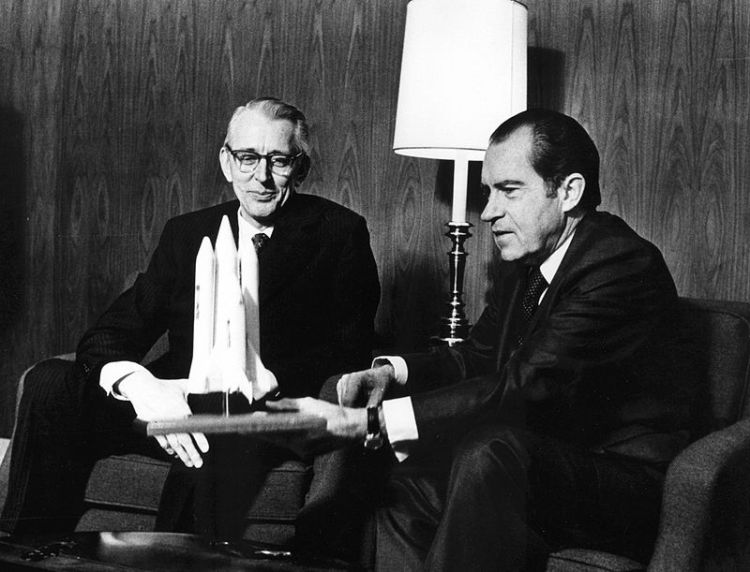
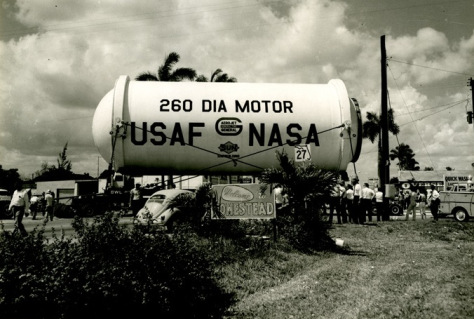
5. Number five on the list of wrong turns was of course the design of the Space Shuttle itself, which wasted most of the lift of a Saturn V class vehicle sending a 737-size glider into low orbit so it could come right back down. A huge cargo bay when there was nothing to bring back down. An extremely maintenance intensive heat shield and “reusable” boosters that were not powerful enough and had to be disassembled and railed to and from Utah after each use. And…no escape system. Note the image at the top of the page of Nixon and a Space Shuttle model features a Shuttle concept using a single 260 inch SRB and a pair of expendable external tanks. This would likely have prevented the Challenger Disaster and using heat resistant alloys and a smaller wing would have prevented the loss of the Columbia. The inferior segmented SRB’s from Utah may have been politically expedient but they were inferior to the Aerojet monolithic design.
1965-260-in.-motor1

6. A most egregious waste of tax dollars, as stated previously, was the 180 billion dollar space station to nowhere. That funding could have been directed toward a “Shuttle C” which would have done away with the Orbiter and had the main engine module come back alone and in some concepts vertically land. It would have followed to develop the liquid boosters originally specified and the result would have had much the same performance as the Saturn V first and second stage. A cargo version of the Shuttle was pursued near the end of the program with the Sidemount proposal which the Augustine Commission, heavily biased toward NewSpace, wanted nothing to do with. Like the Saturn V,  U.S. heavy lift capability was again thrown away in favor of a something-for-nothing-scam. The Space Launch System (SLS) was born out of the ashes and immediately demonized by NewSpace promoters for the obvious reason that it competed with their flagship company for tax dollars. The 4 billion dollars a year spent on going in circles a couple hundred miles up in the ISS should be redirected into a second and third SLS core production line.

7. The most serious and devastating mistake of all was adopting NewSpace. The overriding purpose of Human Space Flight (HSF) is the survival imperative- to guarantee humankind will not be rendered extinct by any natural or human-caused events. In the 1970’s Gerard K. O’Neill, the prophet of space colonization, envisioned miles-in-diameter hollow artificial moons manufactured from lunar resources as the next step for humankind. O’Neill foresaw Space Solar Energy as the economic engine driving colonization and also a cure for global warming. Instead of colonization we have NewSpace. Tens of thousands of pieces of space junk and shiny starships to Mars for the rich is the plan. The ruinous effects of this pernicious ideology have yet to be realized.

The late 1980’s and early 90’s again saw opportunities for the space agency in the form of Shuttle C and a new concept in Nuclear Pulse Propulsion:   https://www.nasa.gov/pdf/361842main_15%20-%20Augustine%20Sidemount%20Final.pdf

Click to access 00189777.pdf

The 75 ton lift of Shuttle C could have enabled “Medusa Missions” to the outer solar system. Concerning the politics involved, Solem writes:
“We are currently prohibited by treaty from: (1) deploying weapons of mass destruction
in space and (2) testing nuclear weapons in space. MEDUSA violates neither the letter
nor the spirit of either prohibition, but it does use nuclear explosives. The radioactive
debris from MEDUSA’s exhaust is so finely dispersed that it will be nearly undetectable.
I assert that MEDUSA’S net environmental impact is less than NERVA; you have to do
something with the spent reactor. I see no reason why nuclear explosive propulsion for
interplanetary missions cannot be made politically acceptable. Perhaps we can be more
creative and consider an international mission in which the nuclear explosives were jointly supplied by the superpowers. What a wonderful approach to nuclear disarmament and the enhancement of science for the benefit of all humanity!”

Ceres would have been a likely first destination for a Medusa ship. What could have been. George Santayana is often misquoted in that usually only the last part of his most famous saying is stated: “Progress, far from consisting in change, depends on retentiveness. When change is absolute there remains no being to improve and no direction is set for possible improvement: and when experience is not retained, as among savages, infancy is perpetual. Those who cannot remember the past are condemned to repeat it.”

To retain what has been learned, to see the direction that would have improved our being, that is what saves us from condemnation. Like Santayana’s perpetual infant we are not remembering. Right now we have the resources to effectively expand humankind into the solar system and guarantee our survival. That may not last.

And that could be our last mistake.


Meaning around 60

https://www.livescience.com/age-when-life-has-most-meaning.html

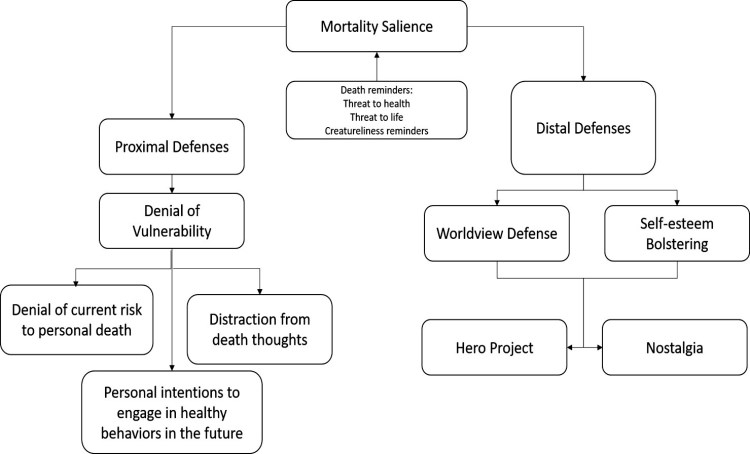
According to this article my search for meaning was important to me in my 20’s and is now at it’s lowest point while my sense that life has meaning was low then and is now at it’s highest. Statistically across a number of individuals. Of course I have to be the unhappy exception. I suspect a study of terror management theory is what is skewing my numbers. The following schematic is not from the article, it is from: https://www.ecologyandsociety.org/vol22/iss3/art32/figure1.html


Mortality Salience

From the article: “It’s not clear whether health and well-being make people feel life is meaningful, or whether people who find meaning in life become healthier. “I suspect that the relationship goes both ways,” Aftab said. “How healthy and functional we are impacts how meaningful we find our lives to be, and that meaning in our lives in turn promotes further health and well-being.”

In my view the key to understanding meaning and my own mortality at this late point in life is my three year old Granddaughter. Across a spectrum of “proximal (conscious, near, and threat-focused) and distal (unconscious, distant, symbolic) defenses” my Granddaughter is the opposite of a threat and in no way unconscious. My death anxiety has more to do with reality than all the stuff we fill up our three pound universe with. I am a simple machine.

When my Father was dying, during a particularly stressful episode when I was very tired, I hallucinated columns of glowing rectangles on the wall. Somewhat like the graphic above. I suspect it had to do with the many years I spent troubleshooting autopilot systems using flow charts. Those rescue helicopters were the most meaningful work of my life. Perhaps I was trying to figure out what was happening and looking for a solution. The solution I was involved in was the endura my Father was going through. I was searching for some kind of consolamentum for him.

Everyone has events burned into their memory- experiences they attach meaning to. In terms of affecting my worldview two stand out. It was only decades later that the first would become important to me but the second had an immediate effect. The first was the Challenger disaster in 1986 and the second was when they took the B-52’s off alert in 1991. I was 26 years old and 31 years old when those events took place. Sadly, I don’t remember much about those 5 years between. Both events connect across generations to my Father and my Granddaughter.

In 1986 I had just began my years in Coast Guard Aviation at an Air Station in the deep south. With my wife and baby daughter in our little apartment I was, at the time of the Challenger disaster, learning how to fuel aircraft as all new mechanics did. I remember that cold morning. Five years later my little girl was in elementary school and the cold war, which had shaped my life in so many ways, was coming to an end. I was checking on the status of a Search And Rescue case in the ops center and I stopped to watch Bush senior on the news talking about taking the bombers off alert. A decade later I watched another historic newscast a few days after my forty first birthday. The end of the cold war had a far stronger effect on me than 911. We had all expected Armageddon. A terrorist attack, even one that killed thousands, was just not that big of a deal.

My Father worked on jet fighters most of his career in the Navy and was at sea for most of my childhood. We never formed any kind of bond. The war with no real battles that everyone feared would be the end of the world was the reason I had no Father. The bright future the space shuttle program promised ended as I was trying to do the exact opposite of what my Father had done. I was in the one military service trying not to fight a war and instead trying to save lives. And going home to my wife and daughter every night instead of leaving them alone for months at a time. I tried to be better than him but never could. I had serious problems with the military culture and was lucky to retire.

My Granddaughter makes all that drama fairly meaningless. All the bitter regrets and unhappiness with society are fading as she grows. When I hear her voice and see her bright eyes nothing else matters except her. The past does not matter; I don’t matter. I was not a big space fan at the time of the Shuttle disaster but these many years later I now finally understand that space is how to save this world for our children. Gerard K. O’Neill was the prophet of space colonization, with the plan humankind needed to survive it’s own sins. Seven months after the B-52’s were taken off alert in 1991 O’Neill died. I did not know about his death and it would not have had much meaning for me then. Now, 28 years later, his vision is even more important as the only likely cure for climate change.

My own death, predicted by averaging the lifespans of my Mother and Father, is less than two decades away. It seems a distant end but looking in the mirror and seeing the rapid advance of aging shows how quickly my story is being read. I remember Dr. Spudis wrote an article on geologic time around a year before his death and he probably had  been diagnosed as terminal and was contemplating his life. It is interesting that while my own mortality is deeply distressing, when I think of my Wife and Daughter and Granddaughter that is what is most profoundly frustrating, depressing, and sad. As I explained to my little girl once, men are by nature expendable. It is women that matter.


Half a Century Later

NASA is going to begin the second space age exactly 50 years after the first one ended.

At the end of 1972 Apollo 17 returned from the Moon and 2022 will mark the 50th anniversary of humankind NOT exploring space. We are going to correct that mistake. As actor William Shatner announced in a recent NASA P.R. video- We are going.

NASA declares first SLS core stage complete

“Think of it as NASA’s Christmas present to America,” said NASA Administrator Jim Bridenstine in an event marking the SLS core stage completion Dec. 9.”

While I consider Bridenstine the best NASA Administrator since the Apollo era and in the running as best ever, and sincerely hope he is carried over into the next administration, I don’t think of this as marking a holiday. Instead, I recall when the Augustine Commission murdered Sidemount and if not for that how the 50th anniversary of Apollo 8 could have seen another trip around the Moon. 2018 should have marked humans again leaving the gravitational field of Earth- enabled by Sidemount. It was a sad time.

“We’re going to do a ‘green run’ test. We’re going to prove its capability, we’re going to get it to the Cape, and we’re going to be ready to launch American astronauts to the Moon again.”

In 2022 we plan to fly humans around the Moon again, 4 years after the 50th anniversary of the first such flight. Ironically, 4 years is how long the first space age lasted. The public really does not understand that Low Earth Orbit (LEO) is only a few hundred miles up and a strong argument can be made that it does not qualify as “space.” LEO was first traveled in 1961 by Yuri Gagarin and following flights into LEO for the next 7 years and 8 months may be considered Human Space Flight (HSF) but Apollo 8 left the gravitational field of Earth far behind in 1968. In my view, LEO was removed from the HSF category at that point in history. Going in circles a couple hundred miles up is not space travel. LEO is not really space while 22,236 miles up is Geostationary Earth Orbit (GEO) where “space” should be demarcated as beginning.

USAF Confirms SpaceX Awaiting FAA Approval for Booster Landing at Cape for Return to Flight

Only 4 years ago I had just started a new job and there was still some debate about whether NewSpace was going to be the train wreck it is now, or die a quieter death. Unfortunately, the flagship company continues to launch satellites, and is starting to strip mine Earth Orbit with their ruinous smallsat constellation. The toxic dragon is still scheduled to carry humans to the space station to nowhere despite having blown up and being an unsafe design. Any debate on public space forums is over as the Musk mob has essentially completed their program of hijacking all discourse concerning their cult. Their decade-long propaganda campaign has succeeded in profoundly deceiving the public.

I wish I had the time to popularize this blog and try and get the message out to the public: Space is the Future! Everybody getting rich and living in Musktown on Mars is NOT. I hope and pray a progressive administration will undo some of the damage done by corporatism and neoliberalism- and that space will be a fundamental part of that future. I truly believe the best path to preventing a climate catastrophe is Space Solar Power, as envisioned by Gerard K. O’Neill. I stated years ago that the mountains of treasure currently expended on stealth fighters, submarines, and missile defense, should be redirected to spaceships.

The strategic deterrent can be relocated to deep space and used in a New Green Deal in the same way World War Two made the original New Deal such a success. Lunar water-shielded “fat workshops” can be used in GEO to support a Carrington-event-proof telecom network of human-crewed platforms. That crew compartment pipeline will enable a fleet of Lunar Cyclers and a bridge across the cislunar sea. Those crew compartments are also the prerequisite to true spaceships. The same infrastructure we create to support building a fleet of “space boomers” can be used to facilitate Space Solar Power. The superpower spaceship fleets can also protect planet Earth from comet and asteroid impact threats.

In contrast, the NewSpace business plan is a dead end.

The worst thing that has ever happened to space exploration.


Wailing and Gnashing of Teeth

NASA and Boeing look ahead to long-term SLS production

“If you buy one SLS rocket, the price is really high. If you buy two, the price goes down significantly, and if you buy the three it keeps going down,” NASA Administrator Jim Bridenstine said-”

It is not one launch every six months that should be the goal, it is six launches in one year, and every year for the next 30 years that should be the NASA position. The 4 billion a year presently being completely wasted on the space station to nowhere would be better spent on building two more SLS core stage production lines. The rivers of tears cried by NewSpace fans if NASA officials were to discuss this option would do my heart good. The 150 metric ton payload target would be no problem if the SLS boosters were replaced with two New Glenn lower stages. This is what is needed to loft a double-hulled “fat workshop.”

In my view the necessary building block for a cislunar infrastructure is a minimum 50 foot diameter fat workshop that has an outer 15 foot envelope filled with lunar water as a cosmic ray shield. A 60 foot diameter stage with a 15 foot outer hull would provide a 30 foot diameter inner hull. By sending these workshops with robot landers to Low Lunar Orbit (LLO) a crew compartment pipeline will be created. The landers go down to the ice and convert some of it into propellent and take the rest up to the workshops and repeat. Eventually the cosmic ray shields will be full and by connecting a pair of workshops with a tether system they can be spun to provide a Near-Sea-Level-Radiation-1-Gravity environment (NSLR1G).

These crew compartment pairs can be used first as LLO space stations and then as Lunar Cyclers and GEO platforms. Their most important application will be for spaceships. Nuclear Pulse Propulsion and NSLR1G enables multi-year missions to the ocean moons of the gas and ice giants. True atomic spaceships with cosmic ray water shields and tether-generated artificial gravity are the logical replacement for the terrestrial strategic deterrent. These space boomer fleets would allow guest scientists to go on voyages of exploration. Placing the nuclear arsenals of the superpowers months away in deep space would ratchet down over half a century of launch-on-warning risk and provide a means to intercept comet and asteroid impact threats. The Ayn-Rand-in-space crowd does not like the idea of progress in space being directly subsidized by the state but it shows how completely clueless they are. Everything comes from the state. https://www.youtube.com/watch?v=VSJjlaggbK0

The SLS has been demonized by the NewSpace mob from the day the program was announced. The reason for this propaganda campaign is not hard to figure out. Literally libraries of death-to-SLS comments have been posted by a legion of cyberthugs because SLS competes for tax dollars with SpaceX, that poster child for corporate welfare. When anyone interrupts the decade-long non-stop infomercial that public space blog forums have become since NewSpace cyberbullies hijacked them, a dogpile of trolls quickly silences them. This kind of exposure drives the SpaceX fans into a frenzy of wailing and gnashing of teeth. They are the most toxic group on the internet as proven by survey.

In a perfect world the Saturn V would NOT have been killed and, instead, would have evolved into the reusable vehicle the space shuttle was meant to be. Instead of retreating to the dead end of LEO the Moon would have remained the focus of Human Space Flight. Instead of an Outer Space Treaty forbidding nuclear weapons it would have embraced the use of nuclear energy in space outside the Earth’s magnetosphere. Interestingly, Human Space Flight, with human-rating standards and escape tower technology, was the best path to transporting fissile material Beyond Earth Orbit with the least risk. It is not widely publicized that landing back rockets was NOT invented by SpaceX but is actually technology from almost 30 years ago. After only two years of development the McDonnell Douglas Delta Clipper rocket landed back in 1993.

Hindsight can sometimes be engaged retroactively by resurrecting and repurposing an old concept. The Falcon 9 is essentially an upgraded design of the 1961 Saturn I rocket with Soviet propellent super-cooling added. The Saturn I rocket engine was the H-1, development began in 1958 to upgrade an earlier engine to a thrust of 205,000 pounds, a thrust to weight ration of 102.47 to 1, and a seal level Isp of 255 seconds. The Merlin engine used by the Falcon 9 used technology developed by TRW for NASA in 1964 for the lunar lander. The Merlin has slightly better numbers and must “hover slam” land back, unlike the Delta Clipper. The hobby rocket payload is appropriate for satellites but far below what is necessary for any Human Space Flight Beyond Earth Orbit (HSF-BEO) applications.

In retrospect the mighty Saturn V first stage could have been modified to land back and be reused. The most efficient arrangement for the shuttle would likely have been two large turbopumps driving 4 thrust bells of well over 2 million pounds of thrust each and a smaller central gimbaled engine capable of landing the stage. Likewise the second stage would have landed back but just the engines and some feeder tanks, which would have separated from the stage just short of orbital velocity and then reentered using a heat shield with the stage structure expended. The first stage would have ideally used 4 large thrust bells and one small one while the second stage one large central bell and 4 much smaller ones for landing the engine section. The third stage would have been a single engine wet workshop with a lunar lander (and it’s engine) and may have even recovered it’s single engine using a free return lunar trajectory, heat shield, water barrier, and parachutes. This works out to 12 liquid fuel engines of 6 different types powering 3 stages and a lunar lander.

Sadly, the space shuttle was designed by committee, some say with a secret mission to kidnap Soviet spy satellites driving the requirements. Having served in the military I would say that does not sound like a conspiracy theory and is probably true.


Living off the land- Lunar water is key

By Gary Michael Church

Op-ed | Living off the land: Lunar water is key to crewed space exploration

“These unlit regions within craters, referred to as permanently shadowed regions, or PSRs, are now known to host vast quantities of water ice that have been lying in perfect isolation for hundreds of millions of years. Although an exceedingly difficult number to quantify, it is commonly believed that the quantity of water in these PSRs exceeds 100 million tons.”

Unfortunately, the author also made reference to Helium 3, which automatically inspires  readers who have any technical knowledge concerning the energy industry to conspiracy-theory-eye-roll. As I commented for several years on Dr. Spudis’ blog, the Moon is not likely to become any kind of functioning human colony. The problem is the only way to live on low gravity bodies without suffering debilitation is by way of “sleeper trains” providing artificial Earth gravity. These circular underground trains do not seem practical for any sizeable population. Not a great environment to raise children in unless built on a immense scale and in that case Habitats in space are far superior for several reasons.

In my view the Moon is a factory site. Whether sleeper trains could keep the workforce healthy or they would have to periodically go up to Low Lunar Orbit (LLO) space stations to rehabilitate is one question. If there is only a few hundred million tons of water on the Moon it is not going to last forever and would serve to establish facilities, probably in giant lava tubes, after which small icy bodies would be mined in the asteroid belt and the water transported to the lunar factory sites. The next question is what will these factories on the Moon manufacture? I think…Flying Saucers. I will explain that later.

The first piece of necessary hardware is Super Heavy Lift Vehicle (SHLV) double hulled wet workshops (“Fat Workshops”) launched from Earth. These would be filled with lunar water using robot landers and then pairs with tethers spun to provide near-sea-level-radiation-one-G (NSLR1G) crew compartments. A production pipeline will send these crew compartments first to frozen Low Lunar Orbits (LLO) as a prelude to humans returning to the surface of the Moon. Or, more accurately, to below the surface- as lava tube radiation sanctuaries are the likely destination. Some method of either excavating and using regolith and/or covering small craters might work but really large lava tubes are the ideal.

Once LLO is populated with space stations the next place to send them is Geostationary Earth Orbit (GEO). Water shielded GEO telecom platforms are the answer to a myriad of problems. The smallsat constellations NewSpace is presently pursuing are only going to make those problems an order of magnitude worse and are a terrible mistake. Once a ring of these human-crewed telecom stations are in place then comes a fleet of Lunar Cyclers. In reality it might be more practical to simply do both if the pipeline produces large numbers. Whether humans will launch from Earth to a GEO platform, and then ride some conveyance to intercept a Cycler, or launch on straight intercept missions- is another question.

After the LLO stations, GEO telecom platforms, and the Lunar Cycler fleet, the next step is “true” spaceships. The true spaceship will be capable of multi-year missions to the gas and ice giants. The main challenge in building these spaceships are the “engines” which are of two types; hard discs and soft parachute-like “spinnakers.” The alloy disc becomes more efficient as it gets larger in diameter, and while they could be sent up in “slices” by SHLVs, a disc large enough to be very efficient would mass in the thousands of tons. These discs are the first item on the list to be manufactured on the Moon.

Multi-thousand ton alloy flying saucers forged in underground lunar factories are going to take awhile, and the second type of nuclear pulse engine, the spinnaker, can be put into service immediately. Though not as efficient or able to accelerate as much mass as discs, spinnakers do not first require decades to build a lunar industrial base. The discs will also be used to lift immense masses from the surface of the Moon. After the pipeline of crew compartments and the first discs comes the second major item from lunar factories: Space Solar Power components. Powering planet Earth with solar power beamed down from space is likely the only practical solution to global warming. Along with the energy industry the nuclear industry will relocate to the Moon. U-233 transmuted from lunar thorium will be used in Nuclear Pulse Propulsion systems.

Gerard K. O’Neill made mention of planet Earth heating up due to the burning of fossil fuels in the 70’s and considered it yet one more reason to pursue Space Solar Power. O’Neill saw Space Solar Power as the economic engine to ultimately enable migration from Earth to space colonies, which brings us to the main “product” to be manufactured using lunar resources: hollow artificial “child” moons. Bernal Spheres. These miles-in-diameter spinning habitats are why space is so absolutely important to the survival of humankind. With beam propulsion they can be accelerated to a percentage of the speed of light and sent on centuries long journeys to other stars.

The same Space Solar Power infrastructure that will serve as the economic engine enabling the construction of Bernal Spheres will also enable beam propulsion and at last fleets of jetliners to space carrying millions of passengers every year will ride microwave beams across the cislunar sea. As the next century approaches the population of Earth will begin to decrease and Bernal Spheres will lead and trail our planet in solar orbit. In the next century the Space Solar Power infrastructure will eventually generate enough energy for the first “slow boats” to be sent on their way to other star systems. How freezing people, artificial intellects (“Artilects”), or more likely “Quartilects”, as quantum computers evolve, and black hole starships, will play a part are great subjects for speculation.

In my view black hole starships, using small singularity engines, are the most likely method by which humankind will colonize the galaxy. Before the mind-boggling energies required to creates such engines are available, I suspect god-like artificial intelligence may make other technologies we now believe impossible, or cannot imagine, a possibility. Artilects and star travel aside, it is freezing people that is most likely just around the corner. A successful technique freezing people without damage, thus saving them from death by injury, disease, or old age, would be the most significant event in history. Or…an artificial super-intelligence capable of solving all of humankinds problems regarding mortality and star travel might be the other possible future.

We will see. First we start with the ice on the Moon.


GEMOHOSA and Quartilects

By Gary Michael Church

“June 15, 1940 – Using the Berkeley cyclotron, researchers demonstrate that neutrons captured by uranium 238 lead to the creation of element 94, plutonium.”                                (In 1941 the Manhattan Project begins) http://www.atomicarchive.com/Timeline/Time1940.shtml

“In January 1950, President Truman made the controversial decision to continue and intensify research and production of thermonuclear weapons.” https://www.atomicheritage.org/history/hydrogen-bomb-1950

“On September 27, 1960, The first operational semiconductor IC is created.” https://en.wikipedia.org/wiki/Invention_of_the_integrated_circuit

In 1972 the first modified DNA molecule was created and 2 years later the first genetically modified animal; a mouse.  https://en.wikipedia.org/wiki/Genetically_modified_animal

Star Wars, the Strategic Defense Initiative (SDI), was a proposed missile defense system first announced publicly by President Ronald Reagan on 23 March 1983. https://en.wikipedia.org/wiki/Strategic_Defense_Initiative

I love connecting the dots, probably because of the many years I spent troubleshooting autopilot systems on aircraft. When I see a new development often a pattern springs to mind and I just have to ruminate on it and am driven to fabricate some kind of coherent picture from that pattern. I watched a YouTube video today and went through that routine. In light of artificial intelligence, climate change, and the scourge of neo-liberalism, the modern world is facing an incredibly uncertain future. Most people do not come close to understanding the tremendous changes now in progress. The first silicon computer chip was made the year I was born and almost 60 years later we find humankind in this most disturbing situation. Some of the danger can be blamed on computer technology but it is more a finely woven tapestry of interacting threads woven across the centuries that now seems almost complete. I personally have come to the realization that unless we find a cure for individual mortality our species as a whole is likely doomed. And sooner than we think.

If this blog entry is about an indefinite lifespan a visitor might wonder why all the references to nuclear weapons are necessary. Reading my other entries would paint a picture of a future where an indefinite lifespan has made space travel a necessity and nuclear weapons technology the key enabler. First the fission bomb and then the fusion bomb and then the bomb-pumped laser have made Nuclear Pulse Propulsion (bombs) the sure way to travel through space. The likely technologies run like this; space solar power as the cure for climate change and the economic engine to build hollow artificial moons. Nuclear pulse would be used to lift enormous masses off the surface of the Moon. The resulting space solar power infrastructure would be the cure for climate change and then be used for beam propulsion systems allowing launch vehicles to carry millions of people a year into space.

At some point the space solar power network will be powerful enough to accelerate these artificial moons towards other stars at some percentage of the speed of light. Upon arrival centuries later these “slow boats” will slow down with Nuclear Pulse. But before they do there is one piece of technology required that we don’t have yet: Freezing people without damage thus allowing them to be revived decades or centuries later. And here is the chicken or egg problem: as long as people keep dying we have lebensraum on Earth and don’t need to go into space. Freezing people is just the first step in reversing aging and humankind spreading into the galaxy. If the space solar power network becomes powerful enough it may be able to manufacture small black hole singularity engines to propel “fast boats” close to the speed of light. In this case freezing people may not be needed as time dilation will make for short trips. In fact, the likely scenario for passengers on slow boats is to be awakened early for transfer to fast boats at some point in the voyage.

The second step after freezing people is to be able to extend their lifespan indefinitely. That is essentially what the technology being discussed in the link below is about. Artificial intellects (Artilects as Hugo De Garis calls them) are the wild card. Quantum computers might give rise to “Quartilects” that join with GEnetically MOdified HOmo SApiens in a symbiotic relationship whose goal is to….what? For that I would go back to the Russian Cosmists and their “Common Task” to resurrect the dead.

1:50 to protect eradicate and prevent disease, keeping our aging population healthy.

Space Station vs. Habitat

Several space terms and concepts are abused by NewSpace supporters and used as deceptive P.R. devices. A recent comment from Australia needs to be addressed;

“-(also as far as I aware there’s nothing wrong with calling a Bernal Sphere a space station).”

That’s no space station, it’s a moon. An artificial moon.

Let us start with defining what space itself is. Space, as differentiated from Earth Orbit, should be demarcated at Geostationary Earth Orbit (GEO) 22,236 miles up. NewSpace has pushed much of their business plan for years with propaganda identifying LEO, a couple hundred miles up, as some kind of new frontier. LEO is actually a dead end for Human Space Flight and should not even be classified as such. Comparing LEO to deep space is like comparing a duck pond to the North Atlantic.

Continuing on to spacecraft vs spaceships, what I call the Parker-Dyson-Spudis Continuum is I believe the best guide for understanding the difference between the two. And with the preliminaries out of the way we can now address the subject of space stations. The first problem is that 40 years of LEO space stations have been a tremendous waste of time and resources and proof of why we should abandon LEO as a complete dead end in terms of Human Space Flight. For many years the space station vacation tourist fantasy was NewSpace dogma and has always been a joke to true space enthusiasts. If one goes by certain criteria, the Space Station and the Lunar Cycler are the interesting comparison, since a Shielded Lunar Cycler would be the intermediate step to a true spaceship.

The ISS and those before it are what should be more accurately called “Orbital Platforms” or “OP’s” since they cannot really support long duration missions anywhere except LEO as they lack a cosmic ray shield. A “Space Platform” might have a cosmic ray shield but not artificial gravity and does not have much utility so I doubt they will emerge. A true Space Station would have both a cosmic ray shield and artificial gravity. Shielding and artificial gravity almost certainly equate to lunar water and tether systems as other methods are not very practical. A capable enough propulsion system would make a true Space Station into a Lunar Cycler and a nuclear propulsion system would make it a Spaceship. Such basic practical realities and distinctions need to be understood. A Habitat, as visualized by the space colonization movement of the late 1970’s, is large enough for people to raise families and actually live in indefinitely. The Habitat is thus orders of magnitude larger so tether systems would be replaced by the torus, sphere, or other configurations. In this context calling a Bernal Sphere a Space Station is wrong.

If you look into this NASA study on habitat design you find some mention of material strengths and how strength is a determining factor of size due to artificial gravity stresses. What type of alloy and pattern of construction would be ideal remains to be seen. http://large.stanford.edu/courses/2016/ph240/martelaro2/docs/nasa-sp-413.pdf

In my view the benchmark, after looking at the various concepts, is an artificial moon, a hollow sphere, several miles in diameter, spinning to provide 1G on the inner surface at the equator (a Bernal Sphere). One question of interest is how many miles in diameter? The trick is to provide cosmic ray shielding as well as structural strength, as well as making the structure able to be gradually repaired and likely entirely rebuilt over time so that it will last several centuries or, essentially, as long as structure is being remade over time. These three requirements; 1G, cosmic ray shielding, and gradual regeneration, are the factors to focus on when converting a Habitat design into a Starship design.

A Bernal Sphere converted into a Starship would be accelerated to some percentage of the speed of light out of the solar system by an immense solar powered beam propulsion system. Upon reaching another star several centuries later it would likely use pulse propulsion nuclear devices (bombs) to slow down. Due to the acceleration and deceleration, the more severe interstellar radiation environment, and degradation of structural materials over time, these Habitat/Starships would need to be built to a much higher standard than Bernal Spheres used only as habitats. The smart species would build them to the higher standard from the start.

The missing piece of the puzzle in regards to Star Travel is freezing people. A population reproducing over generations on a “world ship” does not appear desirable and I place it in the category of space elevators as being a lost cause. Suspended animation is, however, not a losing proposition at all since it is a straightforward  problem preventing damage to cells from ice formation. We can likely freeze people without damage and revive them so we should start building the infrastructure now to allow missions to other stars to be launched within a century.

Of course being able to freeze people, as I have written about on this blog, is the ultimate game-changer and would be the most significant event in the history of humankind. Besides having no option except to find a cure for aging, suspended animation also means Star Travel because humans will not stop having children. While it has been calculated the resources are available in the asteroid belt to support space colonies in this solar system with a total population in the tens of billions, interstellar migration is of course the better path to plan on from the beginning.