By Gary Michael Church
The dividing line between science fiction and science fantasy Hollywood producers should be cognizant of is displayed in what I have named the PDSC (Parker-Dyson-Spudis Continuum).
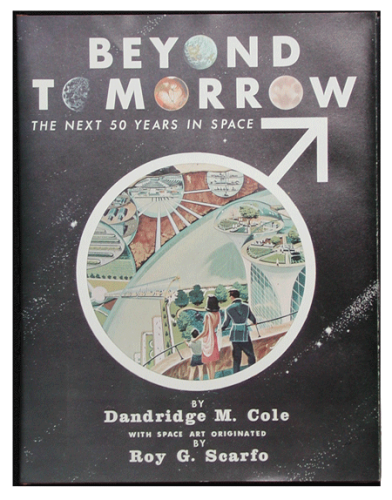 As a boy in the late 1960’s I read and re-read Beyond Tomorrow in the school library. It is probably why this blog exists. Sadly, we have nothing comparable for children today- only the contrived trash Hollywood calls Science Fiction, most of which leans more toward fantasy.
The classic popular science article everyone, including Hollywood producers, should read is Shielding Space Travelers in Scientific American- by the world recognized authority on space radiation, Eugene Parker. Parker passed in 2022. He is the scientist they named the solar probe after. Published in 2006 and available for download, it is revealing that NewSpace fans consistently reject the conclusions stated in this article. It is not only NewSpace that reacts in shock to the idea of 17 feet of water as the “Parker Minimum” and the prerequisite for Human Space Flight Beyond Earth and Lunar Orbit; NASA will not acknowledge the Cosmic Ray Elephant in the room either.

Image credit: Scientific American
In regards to Human Space Flight Beyond Earth and Lunar Orbit (HSF-BELO), or even in the Cislunar Sea between Geostationary Earth Orbit and the Moon (Human Space Flight Beyond Earth Orbit or HSF-BEO) it is generally accepted a “storm cellar” radiation sanctuary will be necessary. Such a sanctuary is for a space-CRAFT and not a space-SHIP. The difference between the spacecraft and true spaceship is the latter will have a bare minimum of 1000 tons of water shielding (for a small crew, several times that for larger crews). Even with this environment launching, transferring between conveyances, and other exposures may eventually add up to a career dose. Not only the kiloton-plus Cosmic Ray Water Shield (CRWS) to address dosing, but a Tether Generated Artificial Gravity (TGAG) system to address the other half of the problem, debilitation, will be required. This Near-Sea-Level-Radiation-One-Gravity (NSLR1G) environment makes the only available form of propulsion for such a large mass a Nuclear Pulse Propulsion system (bombs). Recent advances in ThermoPhotoVoltaic cells may make Nuclear Electric Propulsion an option in the near future.
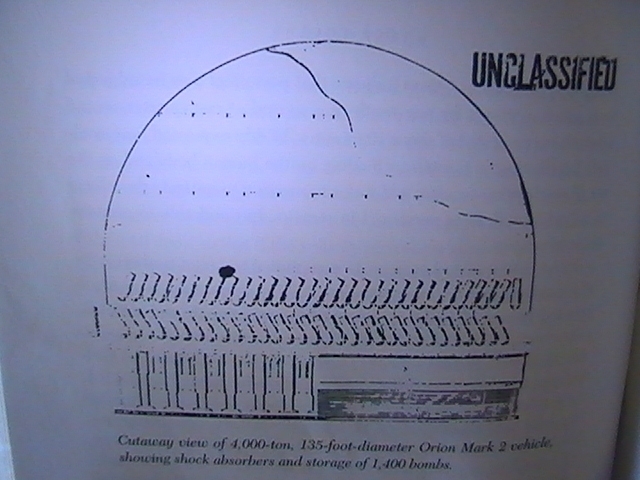
Image credit: Project Orion, the true story of the atomic spaceship, George Dyson
Spacecraft as they have been built to date are virtually unshielded and any mission beyond Low Earth Orbit (LEO) requires a “storm shelter” to protect against solar storms. This kind of sanctuary does not stop cosmic radiation heavy nuclei and in fact generates secondary radiation, so it is actually unhealthier to be in compared to an unshielded area- except during a solar storm of course.
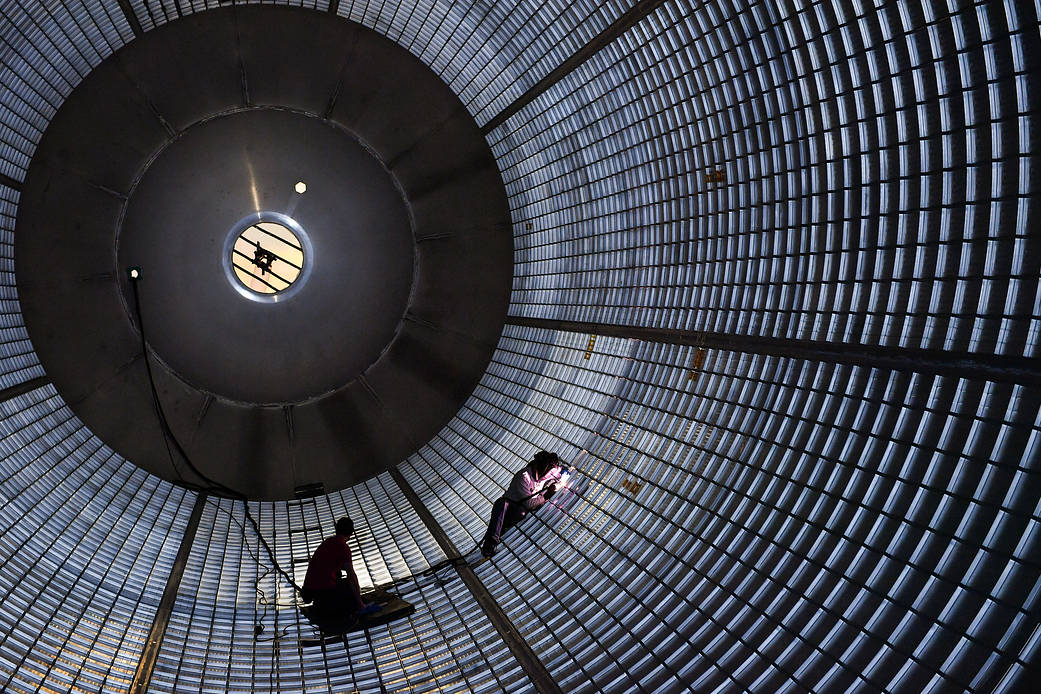
The reality is even crossing the Cislunar Sea between the Earth and the Moon should be done in NSLR1G shielded Lunar Cyclers because a certain percentage of astronauts are going to get caught in storms and suffer profound and career ending dosing otherwise. Spacecraft storm shelters may prevent a career being cut short but due to a lack of a NSLR1G environment these careers are already essentially time limited (especially for young females) due to dosing and debilitation. These are problems that must be completely solved. Any environment that guarantees permanent damage to humans is not going to be a place we inhabit long-term.
Freeman Dyson, who passed in 2020 did the original work on Nuclear Pulse Propulsion during project Orion after Stan Ulam originated the concept in 1947. Paul Spudis made the first really substantial discoveries in 2008 concerning lunar ice and promoted In Situ Resource Utilization (ISRU) till his recent passing in 2018.
The PDSC describes a massive Cosmic Ray Water Shield, the only practical propulsion system to push that shield (Nuclear Pulse Propulsion), and the Moon as the only place to acquire shielding (water derived from lunar ice), assemble, and launch “true spaceships.” Two primary reasons the Moon is the place to go is that the eventually millions of tons of water that will be required for fleets of Spaceships and Lunar Cyclers, and for Space Stations, can be lifted into space using 20 to 25 times less energy than lifting it from Earth- and the Moon is outside the Earths magnetosphere so fallout from pulse propulsion will not get sucked into Earth’s atmosphere.
A recent study suggests there may be less ice on the Moon than originally thought, but there is ice. In fact crashing ice from the asteroid belt into “catch sites” on the Moon and storing the water underground would transform the Moon into an “Ocean Moon.”
There is a short list of sources, Please Read , for anybody in the entertainment industry looking to create science fiction and not science fantasy. Sadly, it appears brain candy fantasy is all the Hollywood community thinks will make money. I believe when a story uses technology as far away from unobtainium and wishalloy as possible, while refraining as much as possible from handwavium, it is far more meaningful and thus more entertaining- and it follows this would be more profitable. And if it promotes a better future that is as good as it gets.
 Ice on the Moon